Introduction
For students exploring the best IT or management college in Patna, the decision today goes far beyond brochures and advertisements. The real question is no longer “Which college looks better?” but rather “Which college will actually shape my career?”
In this context, two institutions frequently come into comparison: CIMAGE Group of Institutions and Amity University Patna.
At a surface level, both offer modern infrastructure, professional courses, and structured academic programs. But when you begin to observe closely—how students learn daily, how they are trained, how exposure is given, and how outcomes are achieved—you start to notice meaningful differences.
This blog presents a deep, descriptive, and practical comparison, designed to help students and parents understand not just what is offered, but how it actually works in real life.
Campus & Infrastructure: Where Learning Actually Happens
CIMAGE – New Campus Designed for Continuous Academic Engagement
With its newly developed campus, CIMAGE has focused on building an environment where infrastructure is not just present—but actively used as part of everyday learning.
From the moment students enter their academic routine, they are consistently interacting with labs, classrooms, and learning tools. Computer labs are not reserved for occasional sessions—they are used regularly for practical implementation, coding exercises, and hands-on activities. This frequent exposure ensures that students do not just understand concepts theoretically, but begin to apply them in real-time situations.
Classrooms are equally dynamic. Instead of a one-way lecture format, sessions often involve PPT-based teaching, student presentations, and interactive discussions. Students are expected to participate, present, and explain, which gradually builds their communication skills and confidence.
Over time, this creates a learning culture where infrastructure becomes an active part of the academic process, not just a facility in the background.
Amity Patna – Standard Urban Infrastructure with Structured Usage
Amity Patna operates within a city-based campus setup, where infrastructure is organized in a structured and functional manner. Classrooms, labs, and facilities are designed to support regular academic delivery in a systematic way.
The environment is clean and organized, providing a disciplined academic setting. However, the usage of infrastructure is largely aligned with scheduled academic sessions, and students may experience fewer opportunities for continuous, hands-on engagement outside structured classes.
Additionally, being a compact urban campus, the experience is centered within the building itself, without the expansiveness seen in larger residential campuses.
Key Observation:
Both institutions offer modern infrastructure, but the distinction becomes clear when you look at how frequently students interact with these resources. One environment encourages continuous engagement, while the other supports structured, session-based usage.
Placements: How Students Are Prepared for the Real World
Placements are often the final measure of a college’s effectiveness—but what truly matters is how students are prepared before they reach that stage.
At CIMAGE, placement preparation is not confined to the final year. Instead, it begins early and evolves gradually. Students are introduced to communication training, interview preparation, technical skills, and professional behavior as part of their ongoing academic journey. This ensures that by the time placement opportunities arise, students are not encountering the process for the first time—they are already familiar with it.
Another important aspect is the focus on overall batch readiness. The system is designed to ensure that a large number of students develop the skills required to participate confidently in placement processes, rather than limiting outcomes to a small group of high performers.
In contrast, Amity Patna provides access to placement opportunities through its institutional network. Students can benefit from these opportunities, but outcomes tend to depend more on individual initiative, preparation, and performance. The level of structured, continuous preparation across the entire batch is comparatively limited.
Key Observation:
The difference lies in the approach—
one builds placement readiness as a continuous process, while the other provides opportunities that students must independently prepare for and utilize.
Courses, Add-ons & Workshops: Extending Learning Beyond the Syllabus
In today’s competitive environment, classroom learning alone is rarely sufficient. The integration of additional skills and certifications plays a crucial role.
At CIMAGE, learning is extended through regular workshops, add-on certifications, and exposure to platforms like NPTEL. These are not occasional activities—they are woven into the academic structure. Students are consistently introduced to tools, technologies, and concepts that are relevant to industry requirements.
This continuous integration ensures that students are not just completing a syllabus, but are also building a practical skill set alongside their academic knowledge.
Amity Patna follows a more curriculum-centered approach, where workshops and seminars are conducted periodically. While these sessions provide value, they function more as supplementary experiences rather than continuous components of the learning process.
Key Observation:
One model integrates skills within the academic journey, while the other introduces them alongside the curriculum at intervals.
Exposure to real-world environments plays a critical role in shaping a student’s confidence and clarity.
CIMAGE incorporates industrial visits and professional interactions as a recurring part of the academic experience. Students gradually gain familiarity with how industries operate, how teams function, and what expectations exist in professional settings. This repeated exposure helps reduce the gap between theory and real-world application.
At Amity Patna, industry interaction is generally facilitated through guest lectures and seminars. These sessions provide useful insights, but they occur less frequently and are often event-based, offering a more limited exposure over time.
Key Observation:
Repeated interaction leads to familiarity and confidence, while occasional interaction builds awareness.
College Life: Engagement with Direction
College life contributes significantly to a student’s personality and confidence.
Amity Patna offers a more general campus experience, where events and extracurricular activities provide opportunities for social interaction and engagement. Students who enjoy participating in diverse activities may find this environment engaging.
CIMAGE also provides opportunities for participation, but many of its activities are aligned with academic development and skill-building. Competitions, presentations, and structured events are often designed to contribute directly to a student’s growth.
Key Observation:
The difference lies in orientation—
one focuses on general engagement, while the other emphasizes purpose-driven participation.
Academics: Learning by Participation vs Learning by Structure
The academic approach of an institution shapes how students absorb and apply knowledge.
CIMAGE adopts a more interactive learning model, where students are encouraged to actively participate in the learning process. PPT-based teaching, continuous assessments, and structured attendance create an environment where students are consistently involved in expressing and applying what they learn.
Amity Patna follows a traditional academic structure, where lectures, internal assessments, and exams form the primary framework. This provides a stable and familiar system, though it involves comparatively less emphasis on continuous student participation.
One approach promotes active engagement and expression, while the other maintains a structured academic progression.
Fees, ROI & Long-Term Value
When evaluating a college, the financial aspect must be considered in terms of return on investment (ROI).
Amity Patna typically involves a higher fee structure, where the value depends on how effectively a student utilizes the available resources and opportunities.
CIMAGE operates with a moderate fee structure, with a strong focus on aligning academics with career readiness and employability.
Key Observation:
ROI is not determined by fees alone, but by how effectively education translates into career outcomes after graduation.
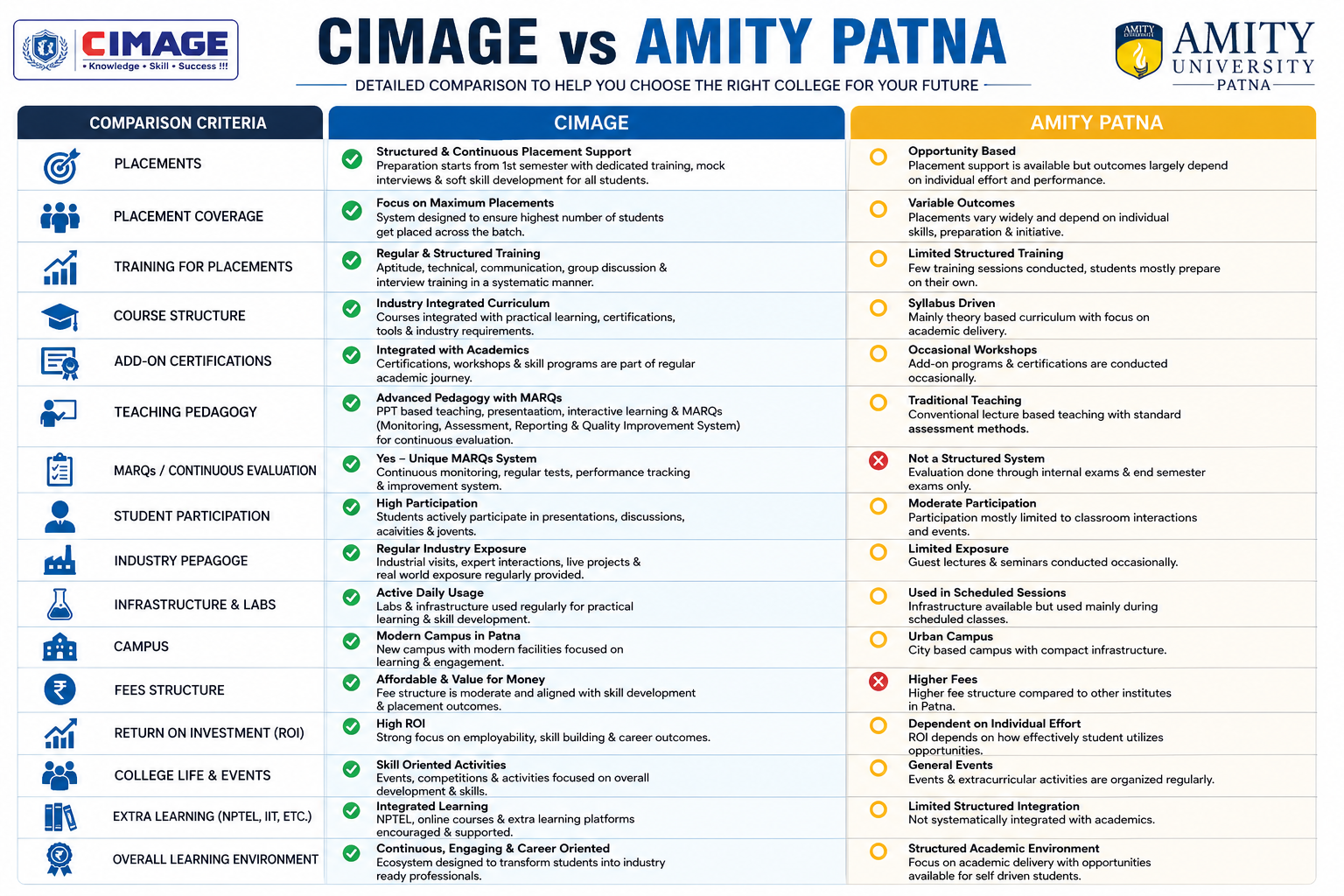
Comparison Table (Quick Reference)
| Comparison Criteria | CIMAGE | Amity Patna |
|---|---|---|
| Placement Approach | Structured, continuous preparation from early semesters with mock interviews and training | Placement support available, but preparation depends on individual effort |
| Placement Coverage | Focus on maximizing placements across entire batch | Opportunities exist, but outcomes vary widely |
| Training for Placements | Regular aptitude, technical, and communication training | Limited structured training sessions |
| Course Structure | Integrated with practical skills and certifications | Primarily syllabus-driven academic structure |
| Add-on Certifications | Built into curriculum (continuous learning) | Occasional workshops and seminars |
| Teaching Pedagogy | PPT-based, interactive, includes MARQs continuous evaluation system | Traditional lecture-based teaching |
| MARQs / Continuous Evaluation | Yes – ensures regular performance tracking | Not a structured system |
| Student Participation | High – presentations, discussions, active engagement | Moderate – mostly lecture-based |
| Industry Exposure | Regular industrial visits and professional interaction | Limited to guest lectures and events |
| Infrastructure Usage | Actively used daily for practical learning | Used mainly during scheduled classes |
| Labs & Practical Learning | Frequent hands-on sessions and real-time practice | Standard lab usage |
| College Life | Skill-based activities and structured engagement | General events and extracurricular activities |
| Academic Approach | Application-oriented and skill-focused | Theory-oriented academic progression |
| Fees | Moderate and aligned with outcomes | Higher fee structure |
| Return on Investment | Focused on employability and career outcomes | Depends on student utilization |
| Industry Integration | NPTEL, practical exposure, skill ecosystem | Limited structured integration |
| Overall Learning Environment | Continuous, engaging, career-oriented | Structured but dependent on self-driven effort |
About the Author