Introduction: Beyond Classrooms, Toward Careers
In today’s competitive academic and professional landscape, the definition of education has undergone a fundamental shift. It is no longer sufficient for students to rely solely on textbooks, lectures, and examinations. Particularly in fields like IT and management, the expectation has evolved—students are now required to understand how industries function, how decisions are made in real environments, and how theoretical knowledge translates into practical outcomes.
This is where industry exposure emerges as a defining element of modern education. It acts as a bridge between classroom learning and real-world application, transforming abstract concepts into tangible experiences. More importantly, it plays a crucial role in shaping student confidence and preparing them for professional life.
Institutions that recognize this shift have begun integrating industry exposure directly into their academic structure. Among them, CIMAGE Group of Institutions has built a model where exposure is embedded into the learning process rather than treated as an occasional activity. Other institutions in Patna, such as Amity University Patna, St. Xavier’s College of Management & Technology, Arcade Business College, and IIBM Patna also offer industry interaction in varying degrees, though the depth and consistency differ significantly.
Understanding Industry Exposure in Today’s Context
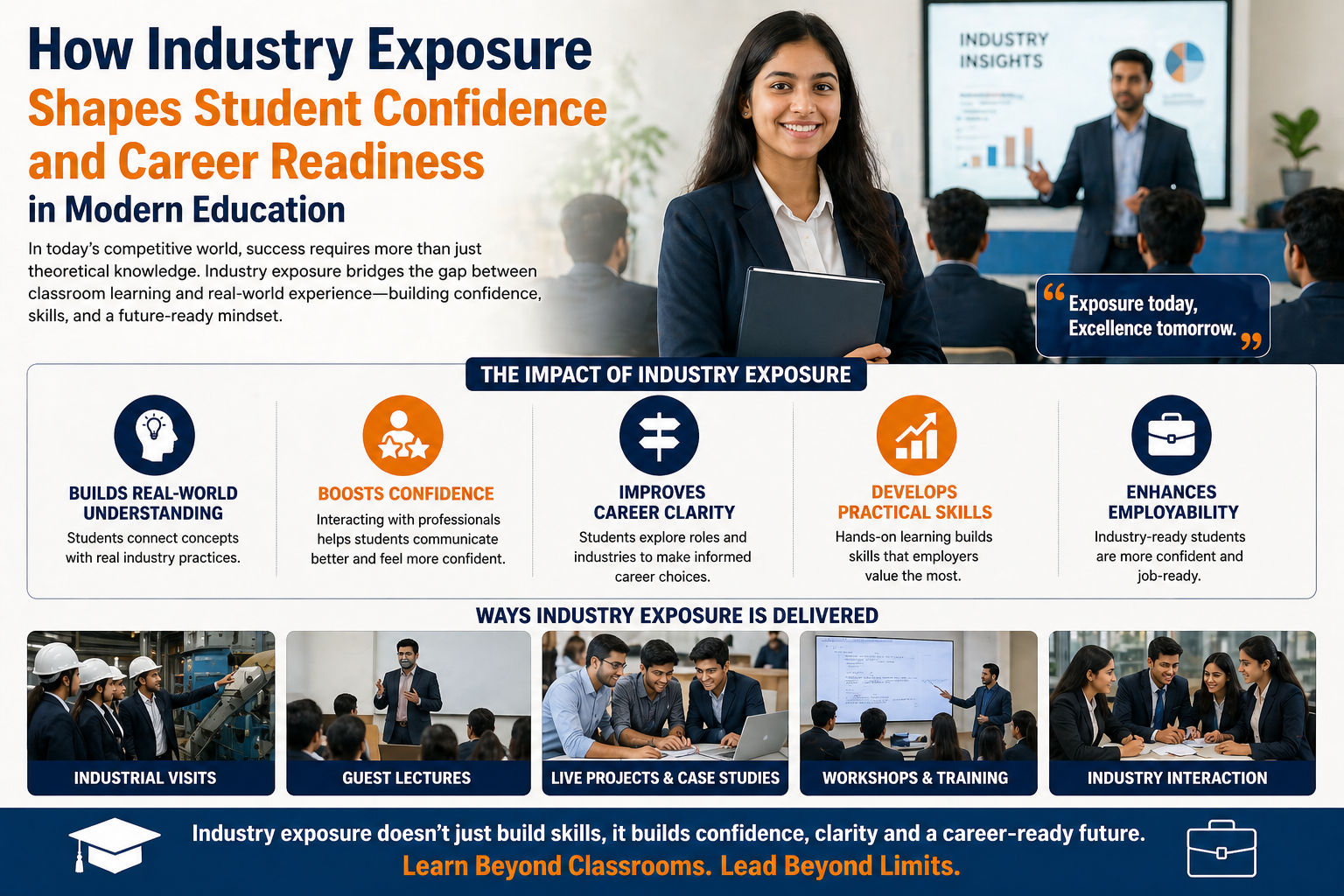
Industry exposure, in its simplest form, refers to a student’s interaction with real business environments, professionals, and operational systems. However, its impact goes far beyond occasional visits or isolated events. It represents a continuous process through which students observe, engage, and gradually adapt to the dynamics of professional life.
When students step outside the classroom and into real or simulated industry environments, they begin to see how concepts are applied in practice. Processes that once seemed theoretical—whether in software development, business strategy, or operations—start to make sense within a real-world context. This transition from passive learning to active understanding is what defines the true value of industry exposure.
The Confidence Factor: Learning to Navigate the Real World
One of the most significant outcomes of industry exposure is the development of confidence. For many students, the transition from college to workplace is not challenging because of lack of knowledge, but because of unfamiliarity with professional environments.
Students studying in institutions where exposure is consistent tend to develop this confidence much earlier. They become comfortable interacting with professionals, participating in discussions, and presenting their ideas.
In contrast, in colleges where exposure is limited or occasional, students often face hesitation during interviews and corporate interactions. The difference is not always in intelligence—it is in experience.
From Confusion to Clarity: Discovering Career Direction
Industry exposure also plays a crucial role in helping students identify their career paths. Many students begin their academic journey without a clear understanding of the roles available to them.
Through exposure to real-world environments, they gain insight into different domains—whether it is software development, data analytics, marketing, or finance. Over time, they begin to align their interests with practical opportunities.
In institutions where exposure is structured and continuous, this clarity develops earlier. In others, students often reach the final year still uncertain about their direction, which affects both preparation and outcomes.
Bridging the Gap Between Knowledge and Application
A major challenge in education has always been the gap between theoretical knowledge and practical application. Industry exposure directly addresses this issue.
Students who regularly engage with real-world scenarios understand how concepts are used in practice. They learn how teams function, how decisions are made, and how challenges are solved in real environments.
In institutions where this integration is strong—such as CIMAGE—the transition from classroom to workplace becomes smoother. In contrast, where exposure remains limited, students often struggle to apply what they have learned.
Variation Across Colleges: The Difference Lies in Execution
While most colleges today claim to provide industry exposure, the reality varies significantly.
Some institutions offer:
- Occasional guest lectures
- Limited industrial visits
- Basic workshops
Others build a complete ecosystem around:
- Continuous interaction with industry
- Practical assignments
- Real-world problem-solving
This difference in execution defines the outcome.
Colleges like Arcade Business College and IIBM Patna provide certain elements of exposure, but the frequency and structure are often not as intensive or integrated. Students in such environments may gain awareness, but not always the depth required for strong career readiness.
Learning by Doing: The Core of Real Preparation
The most effective form of industry exposure is experiential learning—learning by doing.
Students who actively participate in:
- Practical assignments
- Case studies
- Group discussions
- Hands-on workshops
develop a deeper understanding of concepts and stronger problem-solving abilities.
Institutions that emphasize this approach create students who are not only knowledgeable but also capable of applying that knowledge effectively.
Impact on Career Readiness
The difference between a student who has industry exposure and one who does not becomes most visible during placements.
Students with exposure:
- Communicate better
- Adapt quickly
- Understand expectations
- Perform confidently in interviews
Those without it often struggle, despite having similar academic qualifications.
This is why industry exposure directly impacts employability.
The Long-Term Advantage
Beyond immediate placements, industry exposure shapes long-term career growth.
Students develop:
- Professional mindset
- Adaptability
- Confidence in new environments
These qualities help them grow faster in their careers and handle changing industry demands.
Conclusion: Exposure Defines the Outcome
Industry exposure has become a defining factor in modern education. It is no longer enough for colleges to offer degrees—they must prepare students for real-world challenges.
While many institutions in Patna are part of this evolving ecosystem, the difference lies in how deeply they integrate exposure into their academic structure.
For students, the decision is not just about choosing a college—it is about choosing the kind of learning environment that will shape their future.
Because in the end:
A degree may complete education, but exposure completes preparation.
| Parameter | ⭐ CIMAGE Group (Top Choice) | Amity Patna | St. Xavier’s College | Arcade Business College | IIBM Patna |
|---|---|---|---|---|---|
| Industry Exposure Approach | Fully integrated into academics (continuous) | Structured but event-based | Balanced approach | Limited & occasional | Basic exposure |
| Practical Learning Environment | Strong (case studies, real-world tasks) | Moderate | Moderate | Low | Low–Moderate |
| Industrial Visits | Regular & structured | Occasional | Available | Rare | Occasional |
| Guest Lectures | Frequent & diverse | Organized seminars | Regular | Limited | Limited |
| Workshops & Skill Training | Hands-on (AI, tools, job skills) | General workshops | Skill-based programs | Minimal | Basic programs |
| Real-World Application Focus | High (learning by doing) | Moderate | Moderate | Low | Low |
| Student Confidence Development | High (continuous exposure) | Moderate | Moderate | Low | Low–Moderate |
| Career Clarity | Strong (multi-domain exposure) | Moderate | Moderate | Limited | Limited |
| Industry Interaction Frequency | Continuous | Occasional | Periodic | Rare | Occasional |
| Placement Readiness | High (industry-aligned) | Moderate | Moderate–High | Low | Low–Moderate |
| Learning Style | Practical + applied | Structured + theory mix | Balanced | Mostly theoretical | Mostly theoretical |
| Best For | Job-ready careers | Brand & exposure | Balanced growth | Low budget | Legacy + basics |
| Overall Rating | 🏆 Excellent | Good | Good | Basic | Basic–Moderate |
About the Author