BCA vs B.Tech: Which Course Is Better for Your Career in 2026?
The technology industry continues to create exciting career opportunities for students across India. As digital transformation, Artificial Intelligence (AI), cloud computing, cybersecurity, software development, and data science continue to grow, many students face an important question after Class 12:
Should I choose BCA or B.Tech?
While both courses can lead to successful careers in the IT and technology sectors, they differ significantly in terms of duration, eligibility, curriculum, specialization opportunities, career prospects, and learning approach.
This comprehensive guide explores the key differences between BCA and B.Tech to help students make an informed decision about their future.
Understanding BCA and B.Tech
What is BCA?
Bachelor of Computer Applications (BCA) is a professional undergraduate degree focused on computer applications, programming, software development, databases, networking, and emerging digital technologies.
The program is designed for students who want to build careers in software development, IT services, cloud computing, cybersecurity, artificial intelligence, and related technology domains.
What is B.Tech?
Bachelor of Technology (B.Tech) is an engineering degree that combines computer science concepts with broader engineering principles. Students receive deeper technical exposure through engineering fundamentals, practical workshops, hardware concepts, and specialized technological disciplines.
B.Tech is often considered a comprehensive engineering pathway for students interested in advanced technological innovation, engineering design, and research-oriented careers.
BCA vs B.Tech: Quick Comparison
| Parameter | BCA | B.Tech |
|---|---|---|
| Course Duration | 3 Years | 4 Years |
| Eligibility | Arts, Commerce, or Science students (subject to institution requirements) | Science stream with Mathematics mandatory |
| Focus Area | Computer Applications and Software Development | Engineering and Technology |
| Technical Depth | Application-Focused | Engineering-Focused |
| Industry Exposure | IT and Software Industry | IT, Software, Engineering, Research |
| Specialization Options | Primarily IT-related domains | Multiple Engineering Branches |
| Time to Workforce | Faster Entry | Additional Year of Study |
Course Duration: BCA Offers a Faster Route
One of the most noticeable differences between the two programs is course duration.
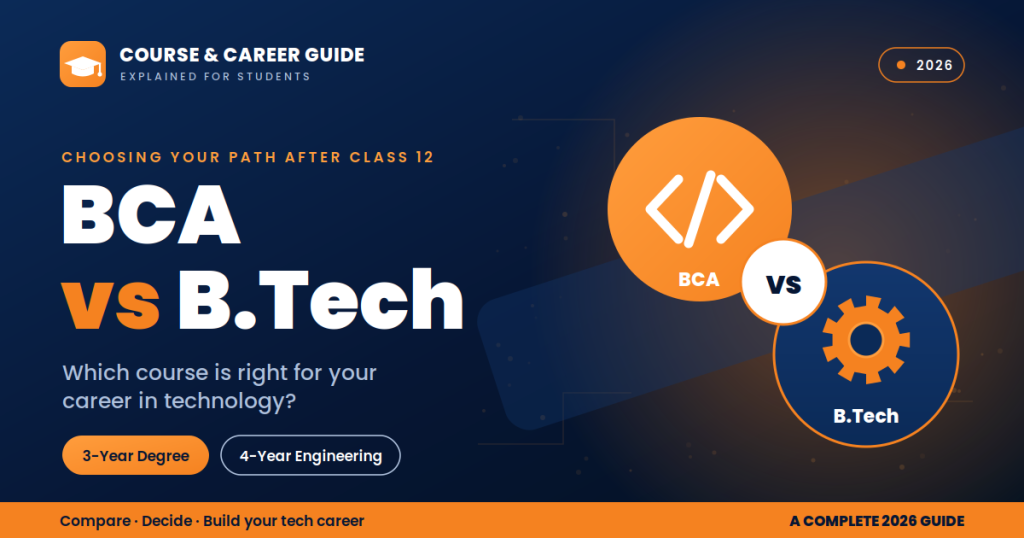
BCA: 3-Year Undergraduate Program
BCA is generally structured as a three-year degree program. This allows students to complete graduation and enter the workforce one year earlier compared to B.Tech students.
For individuals who want to begin earning sooner, gain industry experience quickly, or pursue postgraduate education earlier, this shorter duration can be a significant advantage.
B.Tech: 4-Year Engineering Program
B.Tech requires four years of study because the curriculum includes broader engineering concepts, practical workshops, laboratory sessions, technical projects, and advanced engineering subjects.
While the additional year provides deeper technical exposure, students should evaluate whether this aligns with their long-term academic and career goals.
Eligibility Criteria: Who Can Apply?
Eligibility requirements often become a deciding factor when choosing between BCA and B.Tech.
BCA Eligibility
One of the biggest advantages of BCA is its accessibility.
Students from:
- Arts
- Commerce
- Science
can often pursue BCA, provided they meet the admission requirements of their chosen institution and possess a basic understanding of mathematics and logical reasoning.
This flexibility opens opportunities for students who develop an interest in technology after completing Class 12.
B.Tech Eligibility
For B.Tech programs, especially Computer Science and Information Technology specializations, students are generally required to have:
- Science stream in Class 12
- Mathematics as a compulsory subject
- Eligibility as per entrance examination or institutional criteria
Students without a Science background are usually not eligible for B.Tech programs.
As a result, BCA often serves as an attractive pathway into the technology sector for Arts and Commerce students.
Curriculum and Learning Approach
BCA: Focused on Computer Applications
The BCA curriculum is designed to develop practical and industry-relevant technology skills.
Students typically study:
- Programming Languages
- Database Management Systems
- Software Development
- Web Technologies
- Computer Networks
- Cloud Computing
- Artificial Intelligence Fundamentals
- Data Analytics
- Cybersecurity Basics
The curriculum remains strongly aligned with software development and IT applications.
B.Tech: Broader Engineering Education
B.Tech provides a wider technological perspective through engineering-focused education.
Students are exposed to:
- Engineering Mathematics
- Engineering Physics
- Computer Science Fundamentals
- Hardware Concepts
- Engineering Design Principles
- Technical Laboratories
- Advanced Computing Technologies
In the early years, engineering workshops and laboratory work help build a broader technical foundation that extends beyond software alone.
Specialization Opportunities
BCA Pathways
Students pursuing BCA can build expertise in areas such as:
- Software Development
- Data Science
- Artificial Intelligence
- Cloud Computing
- Cybersecurity
- Full Stack Development
- Mobile App Development
- Business Analytics
The program remains highly focused on careers within the IT ecosystem.
B.Tech Pathways
B.Tech offers a wider variety of specialization options, including:
- Computer Science Engineering
- Artificial Intelligence & Machine Learning
- Information Technology
- Civil Engineering
- Mechanical Engineering
- Electrical Engineering
- Electronics & Communication Engineering
- Robotics Engineering
Students interested in core engineering disciplines generally choose the B.Tech route.
Artificial Intelligence: Which Course Is Better?
Artificial Intelligence is among the fastest-growing technology sectors globally.
Students seeking highly specialized and engineering-oriented AI expertise may benefit from pursuing a B.Tech in Artificial Intelligence and Machine Learning. Such programs often provide deeper mathematical foundations, advanced algorithms, engineering concepts, and research exposure.
However, BCA graduates can also build successful careers in AI through certifications, practical projects, postgraduate education, internships, and continuous skill development.
Ultimately, the better choice depends on a student’s academic background, learning style, and career objectives.
Industry Demand: Has the Gap Reduced?
Historically, many organizations preferred engineering graduates for certain technical roles.
However, the technology industry has evolved significantly over the last decade.
Today, employers increasingly focus on:
- Technical Skills
- Problem-Solving Ability
- Programming Expertise
- Project Experience
- Certifications
- Communication Skills
- Adaptability
As a result, the gap between BCA and B.Tech graduates has narrowed considerably in many areas of the IT industry.
Many organizations now recruit candidates based on their practical abilities and demonstrated competencies rather than solely on degree titles.
Career Opportunities After BCA
Popular career options include:
- Software Developer
- Web Developer
- Full Stack Developer
- Data Analyst
- System Administrator
- Cloud Associate
- Technical Support Engineer
- Cybersecurity Associate
- IT Consultant
Students can further strengthen their career prospects through MCA programs, professional certifications, internships, and specialized training.
Career Opportunities After B.Tech
B.Tech graduates may pursue careers such as:
- Software Engineer
- AI & Machine Learning Engineer
- Data Engineer
- Cloud Engineer
- DevOps Engineer
- Embedded Systems Engineer
- Research Associate
- Core Engineering Professional
- Product Engineer
The broader engineering foundation creates opportunities across multiple industries and technology sectors.
Which Course Should You Choose?
Choose BCA If:
- You are from Arts, Commerce, or Science backgrounds.
- You want a technology-focused career.
- You prefer a shorter 3-year degree.
- You want quicker entry into the IT industry.
- You are interested primarily in software and computer applications.
Choose B.Tech If:
- You have a Science background with Mathematics.
- You want deeper engineering exposure.
- You are interested in AI Engineering, Core Engineering, or Research.
- You prefer broader technological training.
- You are considering engineering specializations beyond software.
Why Students Should Focus on Skills Over Degree Labels
The modern technology industry increasingly values practical skills, real-world experience, and continuous learning.
Whether a student chooses BCA or B.Tech, long-term success often depends on:
- Technical Competence
- Continuous Learning
- Industry Certifications
- Practical Projects
- Internship Experience
- Communication Skills
- Professional Networking
Students who consistently build relevant skills and stay updated with industry trends often outperform peers regardless of the degree they pursue.
Final Thoughts
BCA and B.Tech are both excellent pathways into the technology industry, but they serve different student profiles.
B.Tech offers a broader engineering foundation and deeper specialization opportunities, while BCA provides a focused, industry-relevant, and efficient route into software and IT careers.
The right choice depends on your academic background, career goals, learning preferences, and future aspirations. Rather than asking which course is universally better, students should ask which course aligns best with their interests, strengths, and long-term career objectives.
In today’s rapidly evolving technology landscape, continuous learning, practical skills, certifications, internships, and hands-on project experience often play a greater role in career success than the degree title alone. Students who remain adaptable and committed to skill development will be well-positioned for future opportunities in the digital economy.
About the Author