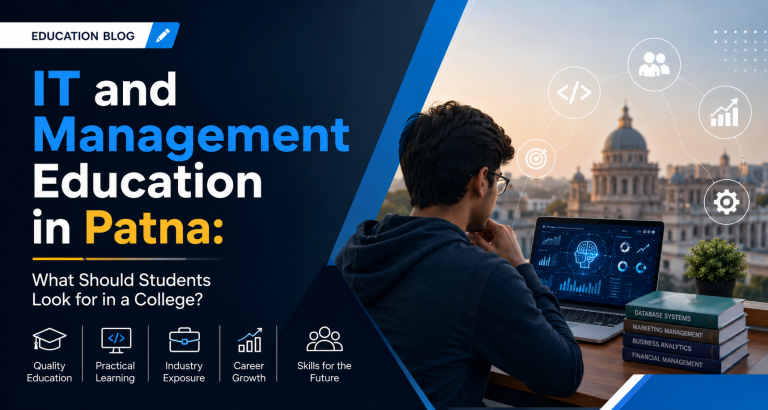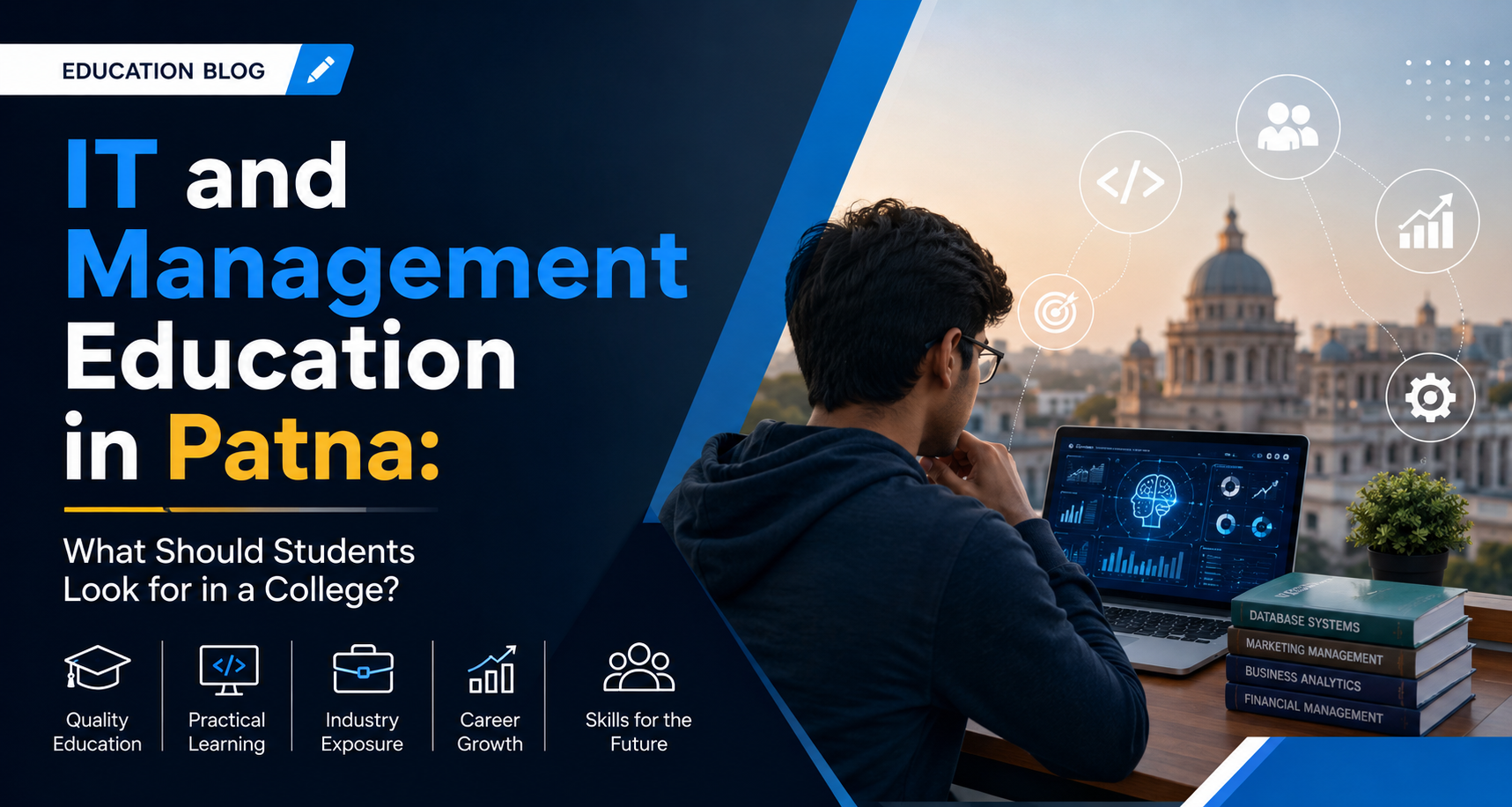
A practical guide for students choosing the right IT and management college in Patna.
Choosing a college after Class 12 is one of the first major decisions students make about their future. For students interested in technology, business, management and digital careers, Patna offers a growing range of educational options.
Courses in Information Technology, Computer Applications, Business Administration, Commerce and Management can lead to diverse career paths. However, choosing the right institution is not simply about selecting a course from a list or looking for the college with the most attractive campus.
The real question is:
What kind of learning, exposure and opportunities will the college provide during the course?
Today, employers increasingly look for graduates who can combine academic knowledge with practical skills, communication, problem-solving ability and an understanding of the workplace. This makes the overall learning environment of a college an important part of the decision.
For students exploring IT and management colleges in Patna, here are the key factors worth considering before taking admission.
Why IT and Management Education Is Changing
The relationship between technology and business has changed considerably.
Technology is no longer limited to the IT department of an organisation. Businesses use technology for marketing, banking, finance, customer service, operations, human resources, sales and decision-making.
At the same time, technology professionals increasingly work on projects that require an understanding of business requirements, customers and organisational objectives.
This has created an increasing overlap between IT and management.
For example:
- Artificial Intelligence is being used for business automation and decision-making.
- Data Analytics supports business intelligence and strategic planning.
- Digital Marketing combines technology with marketing.
- FinTech connects financial services with technology.
- E-commerce combines digital platforms with business operations.
- Product Management brings technology, customer needs and business strategy together.
This does not mean every student needs to study both IT and management. Instead, it highlights the importance of developing skills that complement a student’s core field.
A technology graduate with good communication and business awareness can work effectively with different teams. Similarly, a management graduate with digital and analytical skills can better understand the technology-driven business environment.
What Should Students Look for in an IT or Management College?
There is no single factor that can determine whether a college is right for a particular student.
Instead, students should evaluate the institution across academics, practical learning, infrastructure, industry exposure, faculty, career preparation and overall student development.
1. Start With the Academic Foundation
Academics should remain the starting point when comparing colleges.
For IT-oriented programmes, students may study areas such as:
- Programming
- Database Management
- Computer Systems
- Software Development
- Web Technologies
- Networking
- Data Structures
- Artificial Intelligence
- Data Analytics
- Cloud Technologies
The exact curriculum will depend on the programme and university.
Management-oriented programmes may include:
- Business Management
- Marketing
- Finance
- Accounting
- Economics
- Human Resource Management
- Organisational Behaviour
- Business Communication
- Business Analytics
- Entrepreneurship
A strong academic foundation gives students the concepts required for further learning and professional development.
However, students should not stop at asking “What subjects are taught?”
They should also ask:
“How are these subjects taught?”
A curriculum becomes more valuable when students are encouraged to understand concepts, ask questions, solve problems and apply their knowledge.
2. Look at How Students Actually Learn
Two colleges may offer similar courses but provide completely different learning experiences.
A traditional lecture can introduce a concept, but practical activities can help students understand how that concept works in a real situation.
Depending on the course, students can benefit from:
- Projects
- Presentations
- Case studies
- Group discussions
- Practical assignments
- Business simulations
- Research activities
- Demonstrations
- Problem-solving exercises
For IT students, practical learning can include coding projects, software development, database work, AI activities, robotics, IoT, data analysis and technical competitions.
For management students, it can include business case studies, market research, presentations, financial analysis, entrepreneurship activities and group projects.
The goal is simple:
Students should not only learn information; they should learn how to use it.
The supplied institutional material for CIMAGE similarly describes group discussions, presentations, skill-based training, real-world case exposure, practical assignments and projects as part of its learning approach.
3. Practical Exposure Matters
A professional course should ideally prepare students for situations they may encounter outside the classroom.
This is why practical exposure should be an important part of college selection.
For an IT student, practical exposure could mean:
- Developing applications
- Working on programming projects
- Building websites
- Working with databases
- Exploring AI tools
- Participating in robotics or IoT activities
- Analysing data
- Taking part in hackathons
For a management student, practical exposure could include:
- Business projects
- Market surveys
- Case analysis
- Presentations
- Entrepreneurship activities
- Industry visits
- Business competitions
- Live projects
When visiting a college, students should ask:
How often do students actually work on projects?
That answer can tell you more than a list of facilities on a website.
4. Technology Infrastructure Should Be Functional
Infrastructure is often one of the first things students notice during a college visit.
But infrastructure should be evaluated for its usefulness, not simply its appearance.
For IT education, students can look at whether the college provides functional access to:
- Computer laboratories
- Internet and networking facilities
- Programming environments
- Software tools
- AI and machine learning resources
- Data analytics facilities
- Robotics and IoT resources
- Cloud-based learning environments
For management students, technology-enabled learning can include:
- Business analytics tools
- Digital marketing platforms
- Financial tools
- Data visualisation
- Business productivity software
The important question is not:
“Does the college have a lab?”
It is:
“Do students actually use the lab and technology as part of their learning?”
The CIMAGE material describes smart classrooms, IT laboratories, library resources and dedicated training and placement spaces as part of its infrastructure.
5. Exposure to Emerging Technologies
Technology changes rapidly.
Artificial Intelligence, data analytics, cloud computing, cybersecurity and automation are influencing how organisations work.
Students do not necessarily need to specialise in every emerging technology, but exposure to current developments can help them understand where their field is heading.
For IT students, this may include:
- Artificial Intelligence
- Machine Learning
- Cloud Computing
- Data Science
- Cybersecurity
- IoT
- Robotics
- Automation
For management students, emerging technology can be connected to:
- Digital Marketing
- Business Analytics
- AI-enabled business operations
- Customer analytics
- FinTech
- E-commerce
- Business automation
The CIMAGE material specifically refers to exposure to areas such as DevOps, Drone Technology, Agentic AI and Power BI, alongside workshops and add-on learning opportunities.
However, students should look beyond the terminology.
A college mentioning AI is not enough.
Students should ask:
Will I actually get an opportunity to learn and work with it?
6. Industry Interaction Can Bridge the Gap Between College and Workplace
A college provides academic knowledge, but students also need to understand how industries operate.
Industry interaction can help students become familiar with professional expectations before they graduate.
Useful forms of exposure include:
- Guest lectures
- Industry expert sessions
- Workshops
- Corporate interactions
- Industrial visits
- Internships
- Live projects
- Career sessions
- Professional mentoring
For IT students, an industry expert might explain current software-development practices or emerging technology trends.
For management students, professionals can provide insights into marketing, banking, finance, sales, HR or business operations.
The CIMAGE material describes regular industry interactions, workshops, expert sessions, industrial visits and placement-oriented training as components of its approach.
But students should look at quality rather than simply quantity.
Ten events do not automatically mean better exposure than five meaningful ones.
The important question is:
What did students actually learn or experience through these activities?
7. Internships Should Be More Than Certificates
Internships can give students an opportunity to experience a professional environment before graduation.
But the value of an internship depends on what the student actually does.
Before considering an internship opportunity, students should understand:
- What is the role?
- Is the work related to the course?
- Will there be a mentor?
- Will the student work on real assignments?
- Is there an evaluation?
- What skills can the student develop?
For IT students, meaningful internships could involve software development, testing, databases, analytics, technology support or other relevant areas.
For management students, internships can provide exposure to marketing, sales, finance, HR, operations or business development.
The objective should be learning through experience, rather than simply adding a certificate to a resume.
8. Faculty and Mentorship Matter
A college can have good infrastructure and a strong curriculum, but students still need people who can guide them through their academic journey.
Faculty members influence how easily students understand difficult concepts, complete projects and overcome academic challenges.
Students should consider:
- Faculty experience
- Accessibility of teachers
- Academic mentoring
- Project guidance
- Doubt-solving support
- Feedback
- Career guidance
The CIMAGE material describes experienced faculty, continuous mentoring and academic support as part of its educational approach.
During a college visit, students can also speak with current students and ask:
“How easy is it to approach faculty when you need help?”
This can provide a more realistic understanding of the academic environment.
9. Skill Development Should Go Alongside the Degree
A degree provides an academic qualification.
But employers often evaluate a combination of academic knowledge, technical or business skills, communication and problem-solving ability.
IT students can benefit from developing:
- Programming
- Problem-solving
- Data handling
- Software development
- Analytical thinking
- Technical communication
- Teamwork
- Project management
Management students can benefit from:
- Communication
- Presentation
- Leadership
- Business analysis
- Negotiation
- Team management
- Digital literacy
- Decision-making
These skills can also help students during internships, projects, interviews and workplace interactions.
10. Communication Skills Are Important in Both Fields
Communication is sometimes treated as an additional skill.
In professional life, it is often a fundamental one.
An IT professional may need to explain a technical problem to a client.
A management graduate may need to present a proposal to a team.
A business analyst may need to explain data to senior management.
A project manager may need to coordinate people from different departments.
Students can develop communication through:
- Presentations
- Group discussions
- Seminars
- Debates
- Public speaking
- Team projects
- Interviews
- Professional writing
This is one reason practical, activity-based learning can be useful even for technically oriented programmes.
11. Placement Support Should Be Evaluated Carefully
For many students, placement is an important consideration when selecting a professional college.
However, students should not judge an institution only by the number of company logos displayed on a website.
A better approach is to ask:
- Which companies recruited recently?
- What roles were offered?
- Which courses were eligible?
- How many students participated?
- How are students prepared?
- Are aptitude tests conducted?
- Are interviews practised?
- Are group discussions included?
- Are students informed about national-level recruitment opportunities?
This provides a clearer understanding of the institution’s career-support system.
12. Placement Preparation Is a Continuous Process
Career preparation should ideally begin before the final semester.
Students may benefit from structured preparation involving:
Aptitude Training
Quantitative aptitude, logical reasoning and other assessment-related skills.
Communication Development
Improving clarity, confidence and professional communication.
Group Discussions
Learning how to express ideas while listening and responding appropriately.
Interview Preparation
Understanding how to present academic knowledge, projects and experiences.
Resume Preparation
Learning how to communicate qualifications and achievements effectively.
Company-Specific Preparation
Understanding the recruitment pattern and expectations of different employers.
The supplied CIMAGE material describes placement-oriented training, mock interviews, communication development and structured career preparation.
But students should remember:
A college can provide training and opportunities; selection ultimately depends on the student’s eligibility and performance.
13. Look Beyond Placement Numbers
This is particularly important when comparing colleges.
Placement figures can be presented in different ways.
A number may refer to:
- Students selected
- Students placed
- Students receiving offers
- Students participating in recruitment
- A particular course
- A particular academic year
- Multiple recruitment routes
Therefore, students should ask for context.
The independent research supplied with this article found strong evidence that CIMAGE alumni are working at organisations including TCS, Wipro, ICICI Bank and Cognizant. LinkedIn’s indexed alumni data showed these among the largest employer groups associated with CIMAGE alumni.
The same research also found individual evidence connecting CIMAGE alumni with Accenture and Infosys, and strong evidence for Deloitte selections through its National Level Assessment.
There is also independent student-side evidence of an Airtel campus placement interview at CIMAGE in 2026.
However, the research makes an important distinction: individual or ecosystem-level placement evidence does not automatically independently verify every historical mass-selection number published by an institution.
That is a useful principle for students evaluating any college.
14. Recruitment Does Not Always Mean a Traditional Campus Drive
Modern recruitment can happen through several routes.
These can include:
- Campus recruitment
- Online assessments
- National-level assessments
- Company-specific tests
- Work-integrated programmes
- Off-campus recruitment
- Digital hiring platforms
For example, the supplied research found that CIMAGE students have entered TCS through routes such as TCS Ignite, while Wipro’s work-integrated hiring model can involve online recruitment.
Similarly, the Deloitte selections referenced in the research were through its National Level Assessment, rather than necessarily being a traditional physical campus recruitment process.
This distinction matters.
A student should not judge the value of an opportunity solely by whether an HR team physically visited the campus.
The more important question is:
Did the student receive a genuine opportunity to enter the organisation?
15. Entrepreneurship and Innovation Opportunities
Not every graduate wants to follow a conventional employment route.
Some students may eventually want to:
- Start a business
- Develop a technology product
- Join a startup
- Become a freelancer
- Build a digital business
- Work in a family enterprise
An institution that encourages innovation can provide opportunities for students to explore ideas through projects, competitions, workshops and entrepreneurship activities.
This is another area where IT and management can complement each other.
A technology student may build a product.
A management student may work on:
- Market research
- Pricing
- Marketing
- Finance
- Operations
- Business strategy
Together, these skills can contribute to building a complete business idea.
16. Additional Certifications and Learning Opportunities
Students should also explore whether colleges provide learning opportunities beyond the standard curriculum.
Depending on the programme, these may include:
- Cloud computing
- Artificial Intelligence
- Data Analytics
- Cybersecurity
- Digital Marketing
- Business Analytics
- Financial Technology
- Productivity tools
Additional training can help students explore areas beyond their core subjects.
However, students should not collect certificates simply for the sake of collecting them.
The important question is:
What knowledge and practical ability will this additional programme give me?
A certification becomes more meaningful when it is supported by projects, practice and application.
17. Campus Life and Overall Student Development
Career preparation is important, but college is also a period of personal development.
Students can benefit from participating in:
- Seminars
- Competitions
- Cultural activities
- Clubs
- Sports
- Student events
- Public-speaking activities
- Team projects
- Innovation programmes
These activities can contribute to confidence, teamwork and leadership.
The supplied CIMAGE material describes seminars, competitions, skill-development sessions and academic and co-curricular activities as part of its broader student-development approach.
Students should therefore consider whether the college provides an environment where they can grow both professionally and personally.
18. Return on Investment Matters
The fee of a college should be considered alongside what students receive in return.
The lowest fee does not necessarily mean the best value.
Likewise, a higher fee does not automatically mean better education.
Students and parents should compare:
Total cost of education
with
Academic quality + practical exposure + infrastructure + industry interaction + skill development + career support
They should also consider additional costs such as:
- Transportation
- Accommodation
- Certifications
- Training
- Learning resources
- Other academic expenses
A realistic comparison helps families make a more informed decision.
19. What Parents Should Consider
Parents often focus on fees, discipline, safety, academic reputation and placements.
These are all important.
However, parents should also examine whether students receive opportunities to become independent and professionally confident.
A student may attend classes regularly and pass examinations, but professional development also requires opportunities to:
- Present ideas
- Work in teams
- Solve problems
- Communicate professionally
- Participate in projects
- Interact with industry
- Prepare for interviews
Parents can therefore ask colleges about the complete student-development process rather than focusing only on examination results.
CIMAGE as an Example of Career-Oriented Education in Patna
A neutral educational article should not declare one institution to be automatically “the best.”
Instead, institutions can be considered against the same parameters.
Within Patna’s education ecosystem, CIMAGE Group of Institutions provides an example of an institution that combines professional education with practical learning, technology exposure, industry interaction and career preparation.
Its institutional material describes:
- Smart classrooms
- IT laboratories
- Library facilities
- Dedicated training and placement spaces
- Industry interactions
- Workshops
- Expert sessions
- Industrial visits
- Placement-oriented training
- Skill-development activities
- Seminars and competitions
The broader CIMAGE ecosystem also includes professional programmes across IT, management and related areas, with additional learning opportunities covering technologies and industry-relevant skills.
Its placement ecosystem has also received substantial independent corroboration.
The research supplied for this article found LinkedIn data showing Wipro, TCS, ICICI Bank and Cognizant among the largest employers represented in CIMAGE’s indexed alumni population.
It also found identifiable CIMAGE alumni at companies such as Accenture and Infosys, while Deloitte selections were supported through student profiles and the institution’s reference to Deloitte’s National Level Assessment.
The evidence is not identical for every recruiter, and exact historical mass-selection figures should not automatically be treated as independently audited.
For students, this is actually an important lesson:
A college should be evaluated using both the opportunities it provides and the evidence available about student outcomes.
IT and Management Are Increasingly Connected
The modern workplace demonstrates why students should understand the relationship between technology and business.
Consider a company developing a new digital product.
The technology team may be responsible for:
- Software development
- Database management
- Security
- Infrastructure
- User experience
The business side may be responsible for:
- Market research
- Customer acquisition
- Pricing
- Finance
- Sales
- Business strategy
The success of the product depends on both sides working together.
This is why areas such as business analytics, digital marketing, FinTech, product management, technology consulting and technology entrepreneurship continue to connect IT and management.
Students do not need to become experts in everything.
But developing some understanding of the other side can make them more adaptable professionals.
How to Decide Between IT and Management
Students who are unsure about their direction can begin by understanding their interests.
IT may suit students who enjoy:
- Computers
- Programming
- Logical thinking
- Technology
- Data
- Problem-solving
- Building digital products
- Experimenting with new technologies
Management may suit students who enjoy:
- Business
- Communication
- Leadership
- Marketing
- Finance
- Organising activities
- Working with people
- Entrepreneurship
There is also an overlap between the two.
Students interested in both technology and business may eventually explore fields such as:
- Business Analytics
- Product Management
- Digital Marketing
- FinTech
- Technology Entrepreneurship
- IT Consulting
- Digital Business
The objective should not be to choose the most fashionable course.
The objective should be to choose a field that matches your interests, abilities and long-term career goals.
A Practical College-Selection Checklist
Before taking admission, students and parents can use this checklist.
Academic Quality
- Is the curriculum relevant?
- Are the faculty members qualified and accessible?
- Is practical learning included?
- Is academic mentoring available?
- How are projects and assignments evaluated?
Technology
- Are computer labs functional?
- Do students actually use them?
- Is there exposure to emerging technologies?
- Are students encouraged to build projects?
Industry Exposure
- Are industry professionals invited?
- Are workshops conducted?
- Are industrial visits organised?
- Are internships available?
- Are live projects offered?
Career Preparation
- Is there structured placement training?
- Are aptitude tests practised?
- Are mock interviews conducted?
- Are communication skills developed?
- Are students prepared for different recruitment routes?
Student Development
- Are presentations encouraged?
- Are group discussions conducted?
- Are competitions and seminars organised?
- Are there leadership opportunities?
- Are co-curricular activities available?
Financial Considerations
- What is the complete course fee?
- Are there additional charges?
- Are certifications included?
- Are training programmes charged separately?
- What is the overall value of the programme?
Campus Environment
- Are classrooms comfortable and functional?
- Are laboratories accessible?
- Is the library useful?
- Is the environment disciplined?
- Are students encouraged to participate in activities?
Questions to Ask During a College Visit
A college visit can help students move beyond promotional information.
Instead of asking only “Do you have placements?”, ask specific questions.
Ask the placement team:
Which companies recruited students most recently?
What roles were offered?
Which courses were eligible?
How are students prepared for recruitment?
Are recruitment opportunities campus-based, online or through national assessments?
Ask current students:
How often do you work on projects?
Do students actually use the laboratories?
How accessible are faculty members?
How much industry exposure have you received?
How useful is the placement training?
Ask about fees:
What is the total cost of the programme?
Are there additional training or certification charges?
These questions can help students understand the difference between what a college advertises and what students experience.
Common Mistakes Students Make While Choosing a College
Choosing Only Because of a Famous Name
Reputation can be useful, but it should not be the only deciding factor.
Choosing Only Because of Placement Numbers
Numbers should always be understood in context.
Choosing Only Because of Infrastructure
A modern campus does not automatically guarantee better learning.
Choosing Because Friends Are Going There
Your friend’s career goals may be very different from yours.
Ignoring Practical Learning
A professional course should ideally provide opportunities to apply knowledge.
Ignoring Communication Skills
Technical or academic knowledge alone may not be enough for many professional roles.
Not Visiting the College
Online research is useful, but a physical visit can reveal things that websites cannot.
Looking Only at the First Job
The ultimate goal of education is not simply the first placement. Students should develop skills that remain useful throughout their careers.
Frequently Asked Questions
What should students look for in IT and management colleges in Patna?
Students should evaluate academic quality, faculty, practical learning, technology infrastructure, industry exposure, internships, skill development, placement preparation, student activities and the overall cost of education.
Which factors are most important when choosing an IT college?
For IT programmes, students should pay particular attention to the curriculum, laboratories, practical projects, programming and technology exposure, faculty support, industry interaction and career preparation.
What should students check in a management college?
Students should consider academics, faculty, communication training, business projects, case studies, industry exposure, internships, entrepreneurship opportunities and placement support.
Is practical learning important for IT students?
Yes. IT education benefits significantly from hands-on activities such as programming, projects, technical assignments, laboratories and problem-solving.
Is practical learning useful for management students?
Yes. Case studies, presentations, market research, business projects and industry interaction can help students connect management theory with real-world situations.
Is placement the most important factor when choosing a college?
Placement is an important consideration, particularly for students who want to enter the workforce after graduation. However, it should be considered alongside academics, practical exposure, faculty, infrastructure and overall student development.
Should students trust placement numbers published by colleges?
Students should examine how placement numbers are defined, which academic year they represent and whether they can be independently supported. Different recruitment routes and definitions can affect placement figures.
How are IT and management connected?
Modern businesses depend on technology as well as business strategy. Fields such as business analytics, digital marketing, FinTech, product management and technology entrepreneurship demonstrate this connection.
Are certifications important for students?
Certifications can complement a degree when they provide relevant knowledge and practical skills. Students should focus on the learning value rather than simply collecting certificates.
What should parents consider when choosing a college?
Parents should consider academic quality, fees, safety, discipline, infrastructure, industry exposure, student development and career support. Visiting the institution and speaking with current students can also be useful.
Is CIMAGE suitable for students interested in IT and management?
CIMAGE may be relevant for students looking for professional education combined with practical learning, technology exposure, industry interaction and career preparation. Students should still evaluate the specific programme, fees, campus environment and career goals before making a final decision.
Conclusion
Choosing a college for IT and management education in Patna should involve more than comparing names, advertisements or rankings.
The most important question is what students will actually experience during their years of education.
Will they receive a strong academic foundation?
Will they work on practical projects?
Will they have access to relevant technology?
Will they interact with industry professionals?
Will they develop communication and professional skills?
Will they receive structured career preparation?
Can the institution’s placement information be understood and verified?
And does the overall cost provide reasonable value for the opportunities available?
These questions can help students make a decision based on evidence, individual goals and long-term career plans.
A college can provide the teachers, infrastructure, training, exposure and opportunities. But students must actively participate, practise their skills and make use of those opportunities.
For students exploring IT and management education in Patna, the right college is therefore not necessarily the one with the biggest advertisement or the longest list of claims.
It is the institution that provides an environment where education, practical experience, technology exposure and career preparation come together—and where students can build the skills needed for the future.
About the Author