Introduction
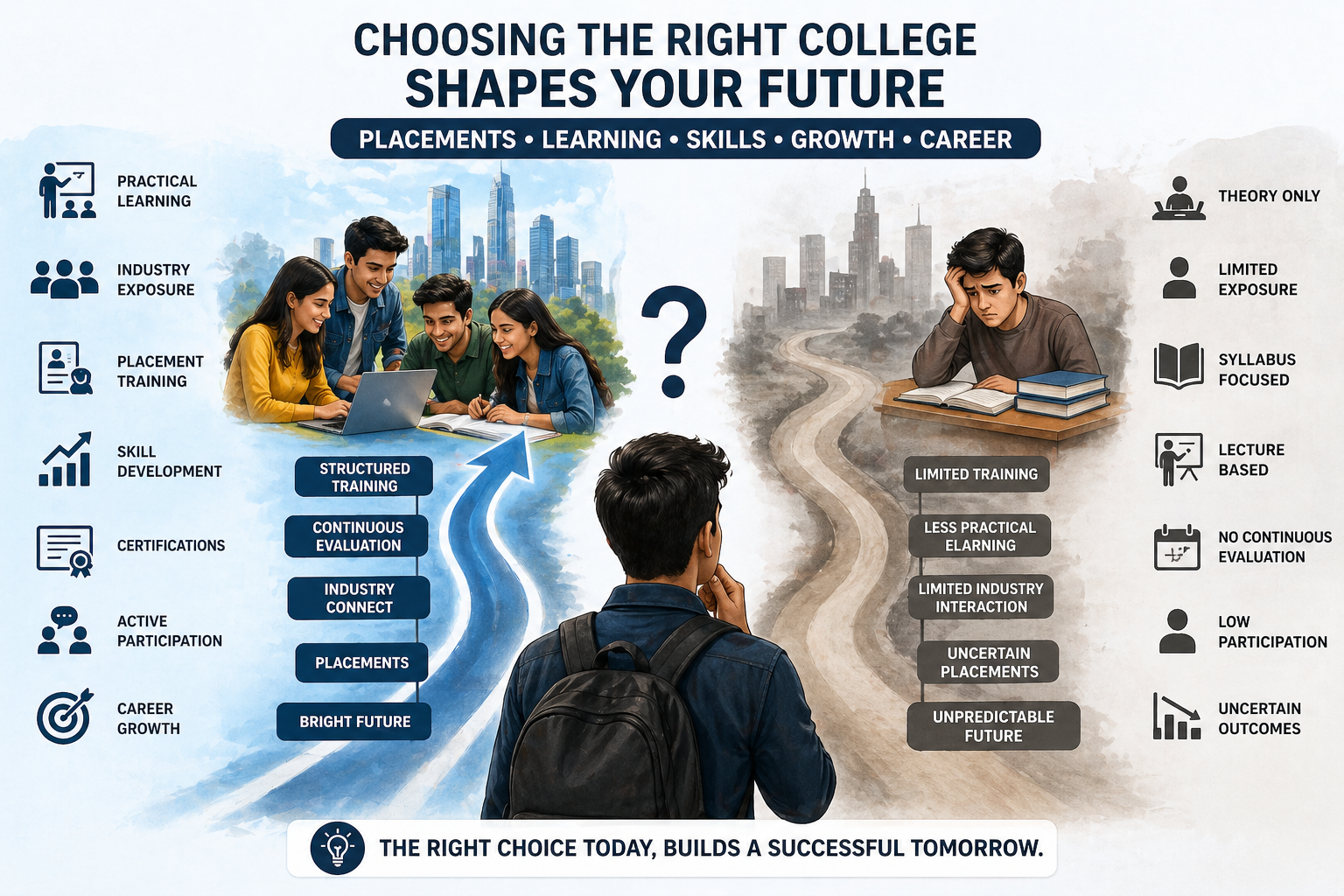
When evaluating the best BCA or BBA college in Patna, students often look at surface-level factors—fees, location, or basic infrastructure. But the real difference between institutions becomes visible only when you analyze how students are trained, how consistently they are guided, and how effectively they transition into careers.
In this detailed comparison, we examine CIMAGE Group of Institutions and Arcade Business College across every critical dimension—from placements to pedagogy to real-world exposure.
Rather than listing differences, this article explains how each aspect impacts a student’s journey over three years.
Placement Approach & Coverage: System vs Self-Driven Effort
At CIMAGE, placement preparation is not treated as a final-year activity. It is a structured, continuous process that begins early in the academic journey. Students gradually move through stages—communication development, aptitude training, mock interviews, and technical preparation—so that by the time placement opportunities arrive, they are already familiar with expectations.
This structured approach naturally leads to a focus on placement coverage across the entire batch, not just a few top performers. The system is designed to ensure that a large number of students are prepared to participate confidently.
At Arcade Business College, placement support may exist in a general sense, but preparation is largely dependent on individual initiative. Students often need to arrange their own preparation, seek external coaching, or rely on personal effort. As a result, placement outcomes tend to vary widely, with no consistent system ensuring readiness across the batch.
Training for Placements: Continuous Development vs Limited Structure
CIMAGE integrates regular training sessions into the academic flow. These include aptitude practice, technical skill-building, and communication development. Students are repeatedly exposed to interview scenarios, helping them build confidence gradually.
In contrast, Arcade Business College offers limited structured placement training. Students may receive guidance at certain points, but there is no consistent, semester-by-semester training framework. This often leaves students preparing on their own, especially closer to graduation.
Course Structure & Add-on Certifications: Integrated vs Occasional Learning
At CIMAGE, the course structure goes beyond syllabus completion. It is integrated with practical skills, certifications, and real-world tools. Students learn concepts alongside their application, which makes the transition from classroom to workplace smoother.
Add-on certifications are not optional extras—they are built into the curriculum, ensuring continuous learning.
At Arcade Business College, the academic structure remains primarily syllabus-driven. While workshops or seminars may occur, they are typically occasional and not deeply embedded into the academic journey. This creates a gap between theoretical learning and practical application.
Teaching Pedagogy & MARQs System: Active Learning vs Traditional Delivery
CIMAGE follows a modern teaching approach that emphasizes interaction and participation. Classes are conducted using PPT-based teaching, where students are encouraged to present, discuss, and engage actively.
A key differentiator is the MARQs (Monthly Assessment Revision Quest), which ensures continuous evaluation. Students are regularly assessed, guided, and improved, making learning a dynamic and evolving process.
Arcade Business College follows a traditional lecture-based pedagogy, where teaching is largely one-directional. Evaluation is primarily based on exams, with no structured system like MARQs for continuous monitoring. As a result, feedback and improvement cycles are less frequent.
Student Participation: Engagement Levels That Shape Confidence
In CIMAGE, student participation is a core part of the academic experience. Through presentations, discussions, and classroom activities, students develop the ability to communicate, express, and think critically.
At Arcade Business College, participation tends to be more limited and lecture-based, with fewer structured opportunities for students to actively engage. This difference directly impacts confidence levels over time.
Industry Exposure & Integration: Familiarity vs Awareness
CIMAGE provides regular industry exposure through visits, interactions, and practical engagement. Students repeatedly encounter real-world environments, helping them understand workplace expectations and culture.
Additionally, platforms like NPTEL are integrated into the learning process, connecting students with advanced knowledge and technical resources.
At Arcade Business College, industry exposure is generally limited to guest lectures or occasional events, providing only surface-level insights rather than continuous familiarity.
Infrastructure, Labs & Practical Learning: Active Usage vs Basic Access
CIMAGE’s infrastructure is designed for active daily usage. Labs are used frequently for hands-on sessions, allowing students to practice and apply concepts regularly. This consistent interaction reinforces learning.
Arcade Business College provides the necessary infrastructure, but usage is typically restricted to scheduled sessions. Practical exposure exists but is not as consistently integrated into daily learning.
College Life: Structured Development vs General Engagement
At Arcade Business College, college life includes general events and extracurricular activities that contribute to student engagement.
At CIMAGE, activities are often aligned with skill-building and academic development. Competitions, presentations, and structured engagements are designed to contribute directly to student growth.
Academic Approach: Application vs Theory
CIMAGE follows an application-oriented academic model, where students learn by doing, presenting, and applying concepts in real scenarios.
Arcade Business College follows a theory-oriented approach, focusing on syllabus completion and exam performance. While this provides foundational knowledge, practical application may be limited.
Fees & Return on Investment (ROI): Cost vs Outcome
Arcade Business College offers a moderate fee structure, which may appear accessible initially.
CIMAGE also maintains a balanced fee structure, but with a strong emphasis on aligning education with career outcomes and employability.
The real difference emerges when considering ROI—
CIMAGE focuses on ensuring that students are career-ready, while at Arcade, outcomes depend more on how much effort students put in independently after graduation.
Overall Learning Environment: Continuous Ecosystem vs Static System
CIMAGE creates a continuous, engaging learning ecosystem, where:
- Students are regularly evaluated
- Skills are developed alongside academics
- Exposure is built over time
- Placement preparation is integrated
Arcade Business College provides a more static academic environment, where:
- Learning is largely classroom-based
- Skill development is less structured
- Outcomes depend on individual initiative
Final Perspective
After evaluating all these aspects together, the difference becomes clear not through claims—but through how each institution shapes a student’s daily experience.
Students should ask themselves:
Do I want an environment that continuously guides, trains, and prepares me?
Or am I comfortable building most of my preparation independently alongside my degree?
Conclusion
The definition of the best BCA/BBA college in Patna is no longer about infrastructure or basic academics—it is about how effectively a college prepares students for real-world careers.
By understanding placement systems, teaching methods, exposure, and ROI in depth, students can make a decision that aligns with their long-term goals, not just short-term perceptions.
| Comparison Criteria | CIMAGE | Arcade Business College |
|---|---|---|
| Placement Approach | Structured, continuous system starting from early semesters with mock interviews, training sessions, and guided preparation for all students | No clearly defined structured placement system; preparation largely left to individual effort |
| Placement Coverage | Focus on maximizing placements across the entire batch, not limited to top performers | Limited visible placement outcomes; results vary significantly student to student |
| Training for Placements | Regular aptitude training, communication development, interview practice, and technical preparation integrated into academics | Limited structured training; students often prepare independently or externally |
| Course Structure | Curriculum integrated with practical learning, certifications, and real-world tools | Primarily syllabus-driven academic structure focused on theoretical completion |
| Add-on Certifications | Built into curriculum with continuous exposure to certifications and skill programs | Occasional workshops or seminars, not consistently integrated |
| Teaching Pedagogy | PPT-based, interactive learning model with presentations, discussions, and applied teaching methods | Traditional lecture-based teaching with limited interactive engagement |
| MARQs / Continuous Evaluation | Dedicated MARQs system for monitoring, assessment, reporting, and continuous improvement | No structured continuous evaluation system beyond standard exams |
| Student Participation | High – students regularly present, participate, and engage in classroom activities | Moderate – mostly lecture-based participation with limited structured engagement |
| Industry Exposure | Regular industrial visits, expert sessions, and real-world interaction integrated into course | Limited exposure; mostly guest lectures or occasional events |
| Infrastructure Usage | Labs and classrooms actively used daily for practical learning and engagement | Infrastructure available but primarily used during scheduled classes |
| Labs & Practical Learning | Frequent hands-on sessions, coding practice, and real-time application of concepts | Standard lab usage with limited continuous practical engagement |
| College Life | Skill-based events, competitions, presentations, and structured development activities | General events and extracurricular activities with less focus on skill development |
| Academic Approach | Application-oriented learning focused on real-world skills and communication | Theory-oriented approach focused on syllabus completion and exams |
| Fees | Moderate fee structure aligned with skill development and placement outcomes | Moderate fee structure but with limited structured career alignment |
| Return on Investment (ROI) | Strong focus on employability and career outcomes after graduation | ROI depends heavily on student’s individual effort after course completion |
| Industry Integration | Exposure to platforms like NPTEL, practical learning systems, and industry-relevant tools | Limited structured integration with industry platforms or advanced learning systems |
| Overall Learning Environment | Continuous, engaging, and career-oriented ecosystem designed to build job-ready professionals | Static academic environment with limited structured guidance for career development |
About the Author