Introduction
Choosing a college in 2026 is no longer just about selecting a campus or earning a degree. Students today are looking for institutions that can prepare them for real careers, evolving technologies, and a highly competitive professional world.
The education landscape is changing rapidly. Companies now expect graduates to be skilled, adaptable, technologically aware, and professionally confident from the very beginning of their careers. As a result, students and parents are becoming more careful while evaluating colleges.
A future-ready college is not simply defined by buildings or advertisements. It is defined by how effectively it prepares students for the future through practical learning, industry exposure, digital education, innovation, and career-focused development.
Why Future-Ready Education Matters Today
The job market in 2026 is becoming increasingly skill-driven. Employers are not only looking for degrees—they are looking for students who can solve problems, communicate effectively, and adapt to changing technologies.
This is why colleges today must go beyond traditional classroom teaching and focus on preparing students for real-world challenges.
Key Insight
Future-ready education focuses on employability, adaptability, and practical growth rather than theoretical learning alone.
The Shift Towards Skill-Based Learning
Traditional education systems mainly focused on lectures, written exams, and memorization. While academic fundamentals are still important, industries now prefer students who can apply concepts practically.
Modern colleges are increasingly introducing:
- Project-based learning
- Live assignments
- Presentations and group discussions
- Practical labs and workshops
- Internship opportunities
- Industry-driven activities
This approach helps students build confidence and improve problem-solving abilities from an early stage.
Key Insight
Skill-based learning helps students become career-ready instead of just exam-ready.
Technology Integration is Becoming Essential
Technology is transforming every industry, including education. In 2026, students are expected to understand modern digital tools and emerging technologies, regardless of their academic background.
Future-ready colleges are introducing students to:
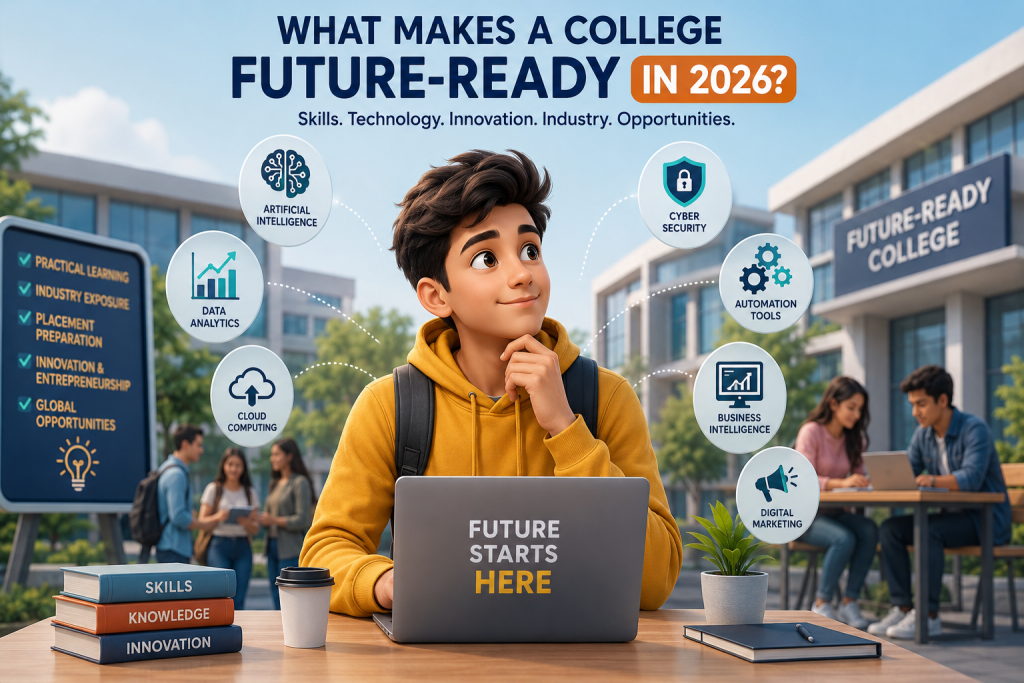
Artificial Intelligence (AI)
Artificial Intelligence is transforming industries like healthcare, finance, education, business operations, and software development. Exposure to AI helps students understand future technologies, automation systems, and intelligent digital solutions that are increasingly becoming part of modern workplaces.
Data Analytics
Data Analytics helps students learn how organizations collect, analyze, and interpret data to make smarter business and operational decisions. It develops analytical thinking and improves problem-solving abilities in data-driven industries.
Cloud Computing
Cloud Computing teaches students how modern websites, applications, and business systems are managed online. It helps students understand digital infrastructure, remote systems, online storage, and scalable technology environments used by global companies.
Cybersecurity
Cybersecurity builds awareness about digital safety, ethical hacking, data privacy, and system protection. As cyber threats continue to increase worldwide, cybersecurity knowledge is becoming important across almost every industry.
Automation Tools
Automation tools help students understand how repetitive technical and business tasks are streamlined using software and intelligent systems. This improves efficiency, productivity, and understanding of modern digital workflows.
Business Intelligence Platforms
Business Intelligence platforms allow students to learn how businesses convert raw data into useful insights for strategic planning, forecasting, and decision-making. These tools are widely used in corporate management and analytics roles.
Digital Marketing Technologies
Digital marketing technologies prepare students for modern marketing methods such as SEO, social media marketing, online advertising, audience analytics, email marketing, and content strategy. As businesses move online, digital marketing skills are becoming highly valuable across industries.
Modern colleges that provide exposure to these technologies often create stronger career opportunities and industry readiness for students.
Key Insight
Technology exposure is no longer optional—it is becoming a core requirement for future careers.
Why Industry Exposure Matters More Than Ever
One of the biggest limitations of traditional education has been the gap between classroom learning and industry expectations.
Future-ready colleges actively bridge this gap through:
- Industrial visits
- Expert sessions
- Corporate workshops
- Live projects
- Internship opportunities
- Placement-oriented training
These experiences help students understand workplace culture and professional expectations before entering the job market.
Students who receive industry exposure during college often adapt more confidently to professional environments after graduation.
Key Insight
Industry exposure gives students practical confidence that textbooks alone cannot provide.
Placements Alone Are Not Enough
Students today are asking smarter questions before admissions.
Instead of simply asking:
“Does the college provide placements?”
They are now asking:
“How does the college prepare students for placements?”
This shift is important because placement success depends heavily on preparation and skill development.
Future-ready colleges focus on:
- Aptitude preparation
- Communication skills
- Mock interviews
- Resume building
- Technical training
- Personality development
- Career mentoring
The goal is not just placement opportunities but genuine career readiness.
Key Insight
Strong placement systems are built on continuous training, preparation, and professional development.
Innovation and Entrepreneurship Culture
Modern education is gradually shifting from passive learning to innovation-driven learning.
Many colleges now encourage students to:
- Build projects
- Participate in hackathons
- Explore startup ideas
- Work on real-world challenges
- Develop entrepreneurial thinking
This kind of ecosystem helps students become creative thinkers and independent problem-solvers.
Even students who do not start businesses benefit because companies increasingly value innovation-oriented thinking.
Key Insight
Innovation culture encourages students to become creators, not just degree holders.
Infrastructure Should Support Learning
Students are often influenced by visually attractive campuses and modern-looking buildings. However, future-ready infrastructure is about functionality rather than appearance alone.
A strong academic infrastructure should support:
- Practical learning
- Collaboration
- Skill development
- Technology integration
- Career preparation
Useful infrastructure may include:
- Smart classrooms
- Computer and coding labs
- Innovation labs
- Libraries with digital resources
- Training and placement centers
- Seminar halls for workshops and industry sessions
Modern infrastructure should create an environment where students can continuously learn, experiment, collaborate, and improve their practical abilities.
Key Insight
Good infrastructure is not just about aesthetics—it is about creating a productive learning ecosystem.
Faculty Mentorship Still Matters
Even in a technology-driven world, faculty guidance remains one of the most important aspects of education.
Future-ready institutions invest in faculty members who:
- Understand industry trends
- Encourage practical learning
- Mentor students personally
- Focus on career growth
- Support skill development
Students often perform better when they learn in supportive academic environments where teachers actively guide them beyond the syllabus.
Key Insight
Strong mentorship helps students grow academically, professionally, and personally.
Students Also Need to Become Future-Ready
A college can provide opportunities, but students must also take initiative to grow.
The most successful students are usually the ones who:
- Learn beyond the syllabus
- Participate actively
- Explore internships
- Build communication skills
- Stay updated with technology
- Practice consistency and discipline
Future-ready education is always a partnership between the institution and the student.
Key Insight
The right college creates opportunities, but student effort turns them into success.
What Students Should Check Before Choosing a College in 2026
Before taking admission, students should evaluate colleges carefully instead of relying only on advertisements or branding.
Academic & Skill Development
- Is the curriculum industry-oriented?
- Does the college focus on practical learning?
Placement Ecosystem
- Is placement preparation structured?
- Are placement records transparent?
Industry Exposure
- Are workshops and industrial visits conducted regularly?
Technology Integration
- Does the institution provide exposure to modern tools and technologies?
Learning Environment
- Is the environment growth-focused and professionally oriented?
Infrastructure Quality
- Does the infrastructure support learning or only marketing?
Key Insight
Students should evaluate outcomes, learning quality, and opportunities—not just advertisements or appearances.
Traditional Colleges vs Future-Ready Colleges
| Feature | Traditional Colleges | Future-Ready Colleges |
| Learning Style | Theory-focused | Practical + skill-based |
| Technology Exposure | Limited | AI, analytics, digital tools |
| Placement Preparation | Basic | Structured and continuous |
| Industry Interaction | Occasional | Regular workshops & internships |
| Student Development | Academic-only | Academic + professional growth |
| Career Readiness | Moderate | High focus on employability |
The Future of Education is Changing Rapidly
Education is evolving faster than ever before.
Students in 2026 are expected to:
- Adapt quickly
- Learn continuously
- Build practical skills
- Understand technology
- Communicate professionally
- Work in dynamic environments
This is why colleges that focus on innovation, industry exposure, practical learning, and career readiness are becoming increasingly relevant.
Key Insight
Future-ready colleges prepare students not just for exams, but for changing industries and evolving careers.
Conclusion
Choosing a college today is not only about earning a degree—it is about preparing for a future that is constantly evolving.
A future-ready college creates an ecosystem where students can:
- Learn practical skills
- Develop confidence
- Understand industry expectations
- Explore innovation
- Grow professionally and personally
As industries continue to evolve in 2026 and beyond, students should focus on institutions that combine academic learning with real-world preparation and long-term career development.
Because ultimately, the best colleges are not simply the ones that teach students—they are the ones that prepare them for the future.
Frequently Asked Questions (FAQs)
1. What is a future-ready college?
A future-ready college focuses on practical learning, industry exposure, digital education, innovation, and career-focused skill development alongside academics.
2. Why is skill-based learning important in 2026?
Skill-based learning helps students apply concepts practically, improve communication, and become better prepared for real-world careers.
3. What technologies should modern colleges teach students?
Modern colleges should provide exposure to AI, data analytics, cybersecurity, cloud computing, automation tools, and digital business technologies.
4. Why is industry exposure important for students?
Industry exposure helps students understand workplace culture, professional expectations, and practical applications through workshops, internships, and industrial visits.
5. Are placements the only factor while choosing a college?
No. Students should also evaluate practical learning, faculty quality, mentorship, technology exposure, infrastructure, and long-term career development.
6. How does practical learning help students?
Practical learning improves confidence, teamwork, communication, problem-solving abilities, and real-world understanding.
7. What should students check before taking admission?
Students should evaluate:
- Placement ecosystem
- Industry exposure
- Infrastructure
- Faculty support
- Skill development opportunities
- Learning environment
- Technology integration
About the Author