Choosing the right course after 12th is one of the first important decisions that can shape your future. At this stage, it is completely normal to feel confused. Many students are expected to choose a career path before they fully understand industries, jobs, or what they truly enjoy doing.
One of the most common dilemmas students face is choosing between a professional degree like BBA (Bachelor of Business Administration) and traditional degree programs like BA (Bachelor of Arts) or B.Sc (Bachelor of Science).
These courses are very different in terms of learning style, career direction, skill development, and future opportunities. That is why the decision should not be based on trends, peer pressure, or what others are choosing.
Many students ask:
Which course is better — BBA or BA/B.Sc?
The honest answer is: there is no universally better course. The right option depends on your interests, strengths, and long-term goals.
A course that works perfectly for one student may not be the right fit for another. What matters most is choosing a path that aligns with:
- Your career goals
- Your personal interests
- Your preferred style of learning
- Your future ambitions
- The kind of work environment you see yourself in
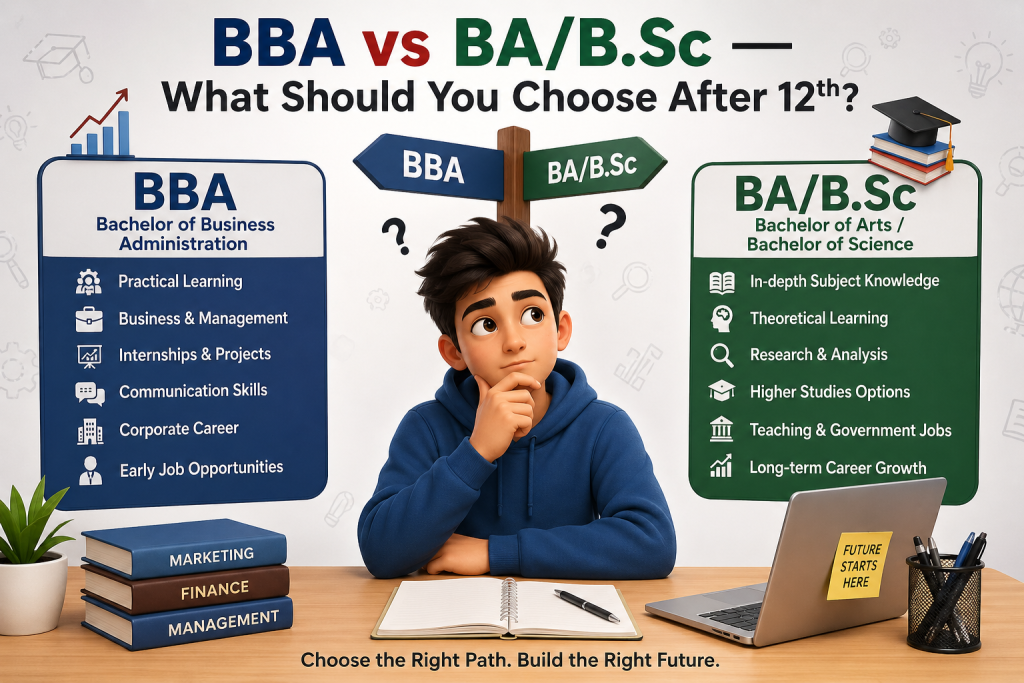
For example, if you enjoy practical learning, business ideas, teamwork, presentations, and understanding how companies work, BBA may be a strong fit.
If you enjoy theory, subject depth, research, reading, analysis, or academic learning, then BA or B.Sc may suit you better.
This blog will help you understand the difference clearly so you can make a smarter and more confident decision after 12th.
Understanding the Basic Difference
Before comparing careers and salary, it is important to understand what these courses are designed for.
What is BBA?
BBA stands for Bachelor of Business Administration. It is a professional undergraduate degree focused on business, management, communication, and corporate readiness.
Students usually study subjects like:
- Marketing
- Finance
- Human Resource Management
- Entrepreneurship
- Business Communication
- Management Principles
- Economics
BBA is often chosen by students who want to enter the corporate world early or plan to pursue an MBA later.
What is BA?
BA stands for Bachelor of Arts. It is a broad academic degree with subject choices such as:
- English
- Psychology
- Political Science
- Sociology
- Economics
- History
- Journalism
BA is ideal for students interested in academics, civil services, teaching, writing, research, or subject specialization.
What is B.Sc?
B.Sc stands for Bachelor of Science. It focuses on scientific and technical subjects such as:
- Mathematics
- Physics
- Chemistry
- Computer Science
- Biotechnology
- Statistics
- Environmental Science
B.Sc is suitable for students who enjoy logical thinking, technical concepts, research, or science-based careers.
BBA vs BA/B.Sc — Learning Style Difference
One of the biggest differences between these courses is how you learn.
BBA Learning Style
BBA usually focuses on practical learning. Students often participate in:
- Group discussions
- Presentations
- Case studies
- Business simulations
- Team projects
- Internships
- Industry visits
This creates early professional exposure and improves confidence.
Students often become comfortable with communication, leadership, and workplace behavior.
BA/B.Sc Learning Style
BA and B.Sc generally focus more on:
- Subject knowledge
- Theory
- Academic understanding
- Written examinations
- Concept clarity
- Analytical thinking
This style is excellent for students who enjoy deep learning and subject mastery.
Neither style is wrong. It depends on what suits you.
Why Many Students Choose BBA After 12th
BBA has become increasingly popular because many students today want early career opportunities and practical exposure.
1. Corporate Readiness
BBA helps students understand how organizations function. You learn about:
- Business decision-making
- Customer behavior
- Team management
- Branding
- Market competition
This gives students real-world awareness.
2. Better Communication Skills
Regular presentations and teamwork often improve:
- Speaking confidence
- Professional communication
- Interview performance
- Personality development
3. Career Flexibility
After BBA, students can explore careers in:
- Marketing
- Sales
- Finance
- Human Resources
- Operations
- Customer Relationship Management
- Business Development
4. Strong MBA Foundation
Many students choose BBA because it creates a natural pathway toward MBA later.
Why BA or B.Sc Can Be a Smart Choice
Traditional degrees are still highly valuable when chosen with clarity.
BA Offers Strength In:
- Civil services preparation
- Law preparation
- Teaching careers
- Content writing
- Journalism
- Psychology careers
- Social sciences
B.Sc Offers Strength In:
- Science-based industries
- Technical roles
- Research careers
- IT pathways (with specialization)
- Data-related fields
- Higher studies like MSc
These degrees can become highly rewarding when combined with specialization and skill-building.
Salary Comparison: BBA vs BA/B.Sc
One of the most common student questions is:
Which course gives better salary?
The reality is simple:
Salary Depends More on Skills Than Degree Name
Your earnings depend on:
- Skills
- Communication ability
- Internship experience
- Certifications
- Confidence
- Practical exposure
- Industry demand
- Continuous learning mindset
BBA Salary Scope
Students who actively build skills during BBA often gain an early advantage.
If you complete internships, certifications, and improve communication, entry-level salaries may begin around:
₹3 LPA to ₹6 LPA depending on college, city, and skill level.
Students with stronger profiles may earn more.
BA/B.Sc Salary Scope
Students who directly enter jobs after graduation may sometimes start lower depending on sector and role.
However, after higher studies, specialization, or competitive exams, earning potential can rise significantly.
Examples:
- BA + UPSC / Government exams
- BA + MA + Teaching
- B.Sc + MSc + Research
- B.Sc + Data / IT certifications
- BA/B.Sc + MBA
So while BBA may offer an earlier earning start, BA/B.Sc can provide strong long-term growth.
Skills You Actually Gain
Degrees matter—but skills matter more.
Skills Commonly Developed in BBA
- Communication
- Presentation ability
- Teamwork
- Leadership
- Problem-solving
- Business understanding
- Decision-making
- Confidence
These are highly valuable in corporate environments.
Skills Commonly Developed in BA
- Critical thinking
- Writing ability
- Deep analysis
- Social understanding
- Research skills
- Communication through academics
Excellent for civil services, academics, content, law pathways, and research-based careers.
Skills Commonly Developed in B.Sc
- Logical thinking
- Technical understanding
- Quantitative analysis
- Scientific reasoning
- Data handling
- Research mindset
Very useful for technical and analytical careers.
Higher Study Options After Graduation
After BBA
Popular next steps:
- MBA
- PGDM
- Digital Marketing Certifications
- Finance Certifications
- Entrepreneurship
After BA
Popular next steps:
- MA
- MBA
- LLB
- UPSC / SSC / Banking exams
- Journalism or Psychology specialization
After B.Sc
Popular next steps:
- MSc
- MCA
- MBA
- Data Analytics
- Research programs
- Technical certifications
All three courses can lead to strong careers if used strategically.
How to Decide What’s Right for You
Instead of asking “Which course is best?”, ask “Which course is best for me?”
Choose BBA If You See Yourself:
- Working in companies
- Building a management career
- Entering marketing or finance
- Starting a business someday
- Learning through practical exposure
- Becoming job-ready earlier
Choose BA If You:
- Love humanities or social science subjects
- Want civil services or law pathway
- Enjoy reading, writing, analysis
- Prefer academic learning
Choose B.Sc If You:
- Enjoy science or technical subjects
- Like logic, numbers, and concepts
- Want research or technical careers
- Prefer analytical learning
Mistakes Students Should Avoid
1. Choosing Because Friends Chose It
Your career path is personal.
2. Choosing Only for Salary
Short-term salary should not be the only factor.
3. Ignoring Your Interest
A course that does not interest you often becomes difficult.
4. Following Trends Blindly
Popular does not always mean right for you.
5. Ignoring Skill Development
No degree alone guarantees success.
Final Thought
BBA vs BA/B.Sc is not a battle of which course is superior.
It is about choosing the path that matches your goals, personality, and future vision.
BBA Gives You:
- Professional exposure
- Practical business skills
- Early corporate readiness
- Strong MBA pathway
BA/B.Sc Gives You:
- Subject depth
- Academic strength
- Flexibility for higher studies
- Strong long-term specialization potential
The smartest decision is not the most popular one.
It is the one that fits who you are and where you want to go.
Choose with clarity, build skills consistently, and whichever course you select can become a successful career path.
Frequently Asked Questions (FAQs)
1: Which is better after 12th — BBA or BA?
It depends on your career goals. BBA is better for business and corporate careers, while BA is ideal for academics, civil services, or humanities-related fields.
2: Is BBA better than B.Sc?
Neither is universally better. BBA suits management careers, while B.Sc is stronger for science, technical, and research pathways.
3: Does BBA offer good salary?
Yes, students with strong skills, internships, and communication abilities can get competitive starting packages.
4: Can BA or B.Sc students do MBA later?
Yes, both BA and B.Sc graduates can pursue MBA and build strong management careers.
5: Which course has more job opportunities?
All three have opportunities. Success depends on skills, specialization, and career planning.
6: Is BBA good for students who want to start a business?
Yes, BBA helps students understand business operations, management, marketing, and entrepreneurship basics.
About the Author