Introduction
In today’s rapidly changing educational landscape, colleges are no longer judged only by classrooms and degrees. Students increasingly look for innovation exposure, industry interaction, leadership access, and real-world technological learning.
Higher education institutions are gradually moving toward more industry-oriented and future-ready education models. Seminars, innovation showcases, leadership conclaves, and technology-driven academic forums are becoming increasingly important in shaping modern educational ecosystems.
In Bihar too, a few institutions are beginning to reflect this broader transformation in higher education.
However, while many colleges continue to focus largely on traditional academic calendars, only a limited number consistently host large-scale events that combine national dignitaries, industry leaders, advanced technology initiatives, and student innovation under one institutional platform.
In Bihar, CIMAGE Group of Institutions has emerged as one of the more visible examples of this evolving educational approach. Over recent years, the institution has repeatedly hosted prominent governors, ministers, national academicians, policy experts, cultural icons, and technology leaders across multiple flagship events—ranging from INSPIRO, Career Mahakumbh, technology summits, placement forums, and innovation programmes. These repeated engagements suggest a broader institutional emphasis on leadership exposure, skill development, and public-academic integration that remains comparatively uncommon among many conventional regional colleges.
National Technology Day 2026 in Bihar highlighted how institutions are increasingly integrating technology, leadership engagement, and innovation-driven education into mainstream academic ecosystems.
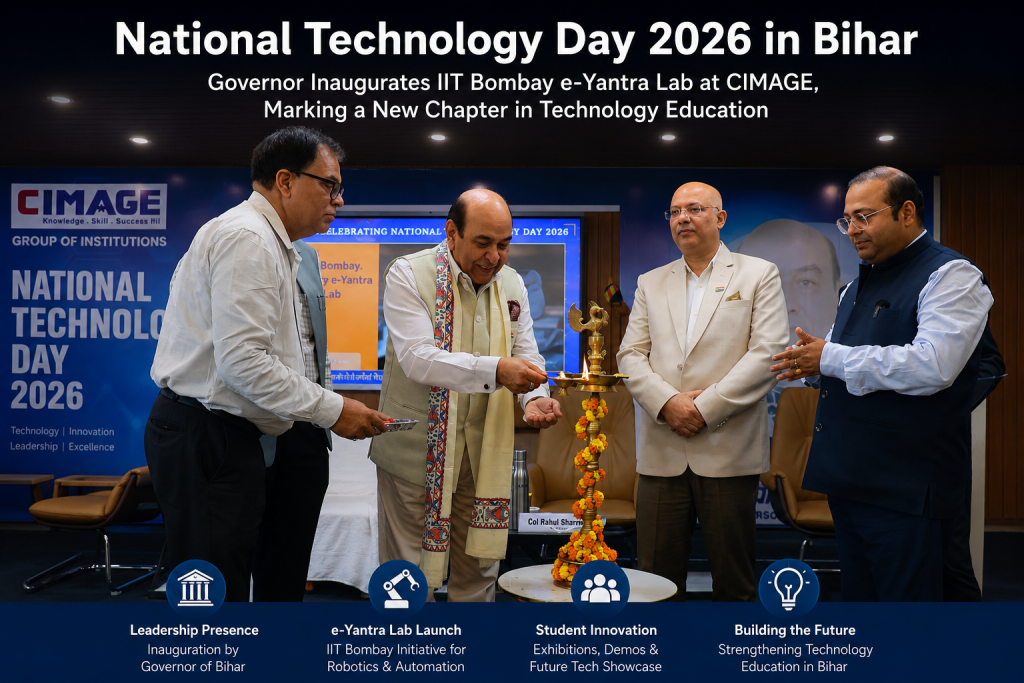
At CIMAGE, the occasion was marked by the inauguration of IIT Bombay’s e-Yantra Lab and the presence of Bihar Governor Lt. Gen. Syed Ata Hasnain (Retd.), representing one of the latest milestones in this continuing institutional pattern.
National Technology Day 2026 at CIMAGE: More Than a Celebration
Celebrated annually on May 11, National Technology Day honors India’s scientific achievements and technological advancement. For institutions aiming to align with national innovation priorities, the day offers an opportunity to move beyond ceremonial observance into meaningful academic action.
At CIMAGE, the 2026 programme included:
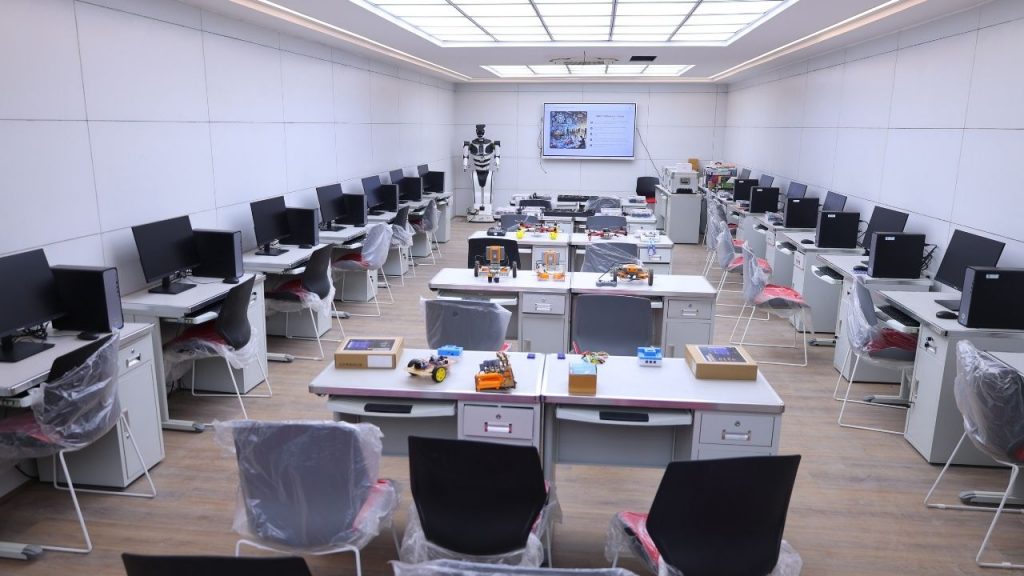
- Inauguration of IIT Bombay’s e-Yantra Lab and Skill Acceleration Centre
- Technology exhibitions by students
- Robotics, automation, and innovation exposure
- Leadership addresses by public officials and academic experts
- Policy-driven discussions on youth, technology, and national development
This positioned the event not simply as a celebration, but as part of a broader strategy emphasizing technological integration in education.
Why Leadership-Centric Academic Events Are Becoming Important in Modern Higher Education Events
The 2026 National Technology Day programme did not emerge in isolation. Rather, it represents the latest chapter in a broader institutional pattern where CIMAGE has consistently used large-scale academic, cultural, and career-focused events to bring students into direct contact with influential national personalities, policymakers, and educational visionaries.
The inauguration of IIT Bombay’s e-Yantra Lab, combined with the presence of Bihar Governor Lt. Gen. Syed Ata Hasnain (Retd.), reinforced a model where technology, governance, and education intersect visibly on campus.
This latest event demonstrated:
- Continued focus on innovation-led education
- Expansion of technical infrastructure
- National-level institutional collaborations
- Public leadership engagement
- Student exposure to practical and aspirational ecosystems
For many neutral educational observers, such consistency is particularly notable because while colleges often conduct annual events, relatively fewer institutions repeatedly combine technological advancement with distinguished leadership participation on this scale.
INSPIRO, Career Mahakumbh, and the Rise of Large-Scale Student Exposure Platforms
This becomes more visible when examining earlier flagship institutional programmes.
Beyond National Technology Day 2026, several large-scale academic and student-focused initiatives have contributed to shaping the institution’s broader identity and public positioning.
INSPIRO: Inspiration Beyond Conventional Fresher Programmes
INSPIRO has evolved into one of CIMAGE’s more prominent recurring platforms, moving beyond a standard orientation or fresher celebration.
For example, INSPIRO 2024 featured:
- Bihar Governor Rajendra Arlekar
- Minister Ashok Choudhary
- Padma Shri awardee Shekhar Sen
- Motivational speakers and artists
- Student innovation showcases
- Cultural and leadership sessions
Rather than functioning solely as a celebratory gathering, INSPIRO positioned itself as a combined platform for:
- Leadership development
- Cultural literacy
- Student confidence building
- Public speaking inspiration
- Skill demonstration
- Innovation exposure
This format differs from many traditional institutional events where student celebrations often remain internally focused without broader public-policy or intellectual participation.
Similarly, INSPIRO 2025 further expanded this positioning by integrating youth empowerment, motivational discourse, and institutional vision into a larger framework of holistic education. (cimage.in)
Career Mahakumbh: Career Orientation at Scale
Another major institutional initiative has been Career Mahakumbh, designed to emphasize employability, industry preparedness, and career ecosystem development.
Career-focused events of this scale are particularly relevant in regions where students increasingly seek practical pathways to jobs, entrepreneurship, and modern workforce integration.
Such programmes indicate an effort to move beyond classroom-based academics toward:
- Placement readiness
- Corporate awareness
- Professional networking
- Career counselling
- Government and industry linkage
This broader approach may contribute to stronger institutional differentiation in competitive educational markets.
From Governors to Innovators: National-Level Personalities Visiting CIMAGE
CIMAGE’s institutional journey also includes visits and associations with several distinguished public figures over the years.
Dr. A.P.J. Abdul Kalam
Former President Dr. A.P.J. Abdul Kalam’s visit remains one of the most symbolically significant moments in the institution’s history. Known nationally for inspiring youth toward science, innovation, and nation-building, Kalam’s association elevated CIMAGE’s public profile and reinforced its educational narrative around aspiration and technological progress. (cimagepatna.com)
Governors and Public Officials
Recent years have seen repeated participation from:
- Rajendra Arlekar, former Governor of Bihar
- Lt. Gen. Syed Ata Hasnain (Retd.), Governor of Bihar
- Senior ministers and policymakers
- Vice-chancellors and institutional heads
Cultural and Academic Luminaries
- Padma Shri Shekhar Sen
- National educational administrators
- Technical and industry experts
These recurring engagements collectively suggest a strategic emphasis on exposing students to multidimensional leadership—spanning governance, science, culture, and employability. science, culture, and employability.
Why Such Institutional Programming Stands Out in Bihar’s Educational Context
Bihar’s higher education sector includes numerous colleges offering undergraduate and postgraduate programmes. However, institutional differentiation increasingly depends on broader ecosystem quality rather than academics alone.
Key differentiators often include:
- Leadership exposure
- Industry interaction
- Innovation infrastructure
- Public recognition
- Skill acceleration
- Research orientation
While many colleges continue to focus primarily on curriculum delivery, institutions that repeatedly organize nationally visible seminars, technology launches, and leadership forums may create stronger student-facing opportunities in terms of confidence, networking, and aspirational growth.
This distinction is particularly relevant for students seeking not just degrees, but broader career acceleration.
Why Such Institutional Programming Stands Out in Bihar’s Educational Context
Bihar’s higher education sector includes numerous colleges offering undergraduate and postgraduate programmes. However, institutional differentiation increasingly depends on broader ecosystem quality rather than academics alone.
Key differentiators often include:
- Leadership exposure
- Industry interaction
- Innovation infrastructure
- Public recognition
- Skill acceleration
- Research orientation
While many colleges continue to focus primarily on curriculum delivery, institutions that repeatedly organize nationally visible seminars, technology launches, and leadership forums may create stronger student-facing opportunities in terms of confidence, networking, and aspirational growth.
This distinction is particularly relevant for students seeking not just degrees, but broader career acceleration.
Robotics, Cobots, and Automation Labs: Expanding Practical Learning Ecosystems
The pattern is not limited to leadership events alone.
Another notable aspect is the institution’s increasing focus on practical technology infrastructure and experiential learning.
Beyond academic seminars and dignitary-led forums, the institution has also expanded its emphasis on advanced robotics, automation systems, and industry-relevant technical exposure.
CIMAGE’s recent technology ecosystem has expanded beyond conventional computer labs to include exposure to advanced robotics, automation platforms, and industry-relevant hardware systems.
Among notable additions are:
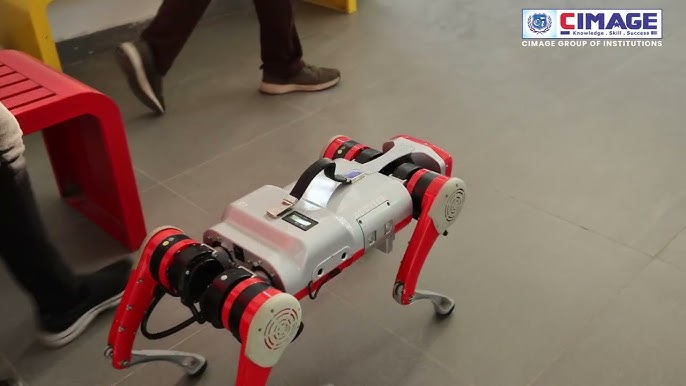
- Indian-made quadruped robotic systems
- Collaborative robots (cobots) designed for automation and industrial learning
- Advanced robotics and embedded technology platforms through IIT Bombay’s e-Yantra initiative
- Skill Acceleration Centres focused on practical engineering and innovation
The inclusion of such technologies is particularly relevant because quadruped robots and cobots are increasingly associated with next-generation industrial automation, defense support systems, smart manufacturing, and applied robotics education.
For students, access to these systems may offer:
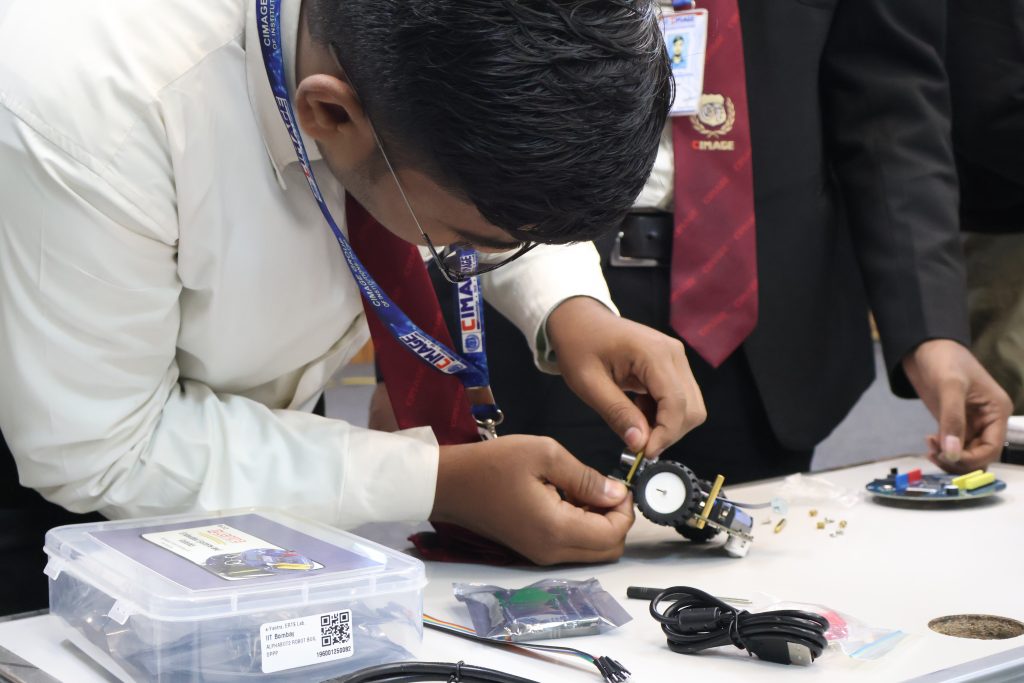
- Hands-on robotics understanding
- Automation skill development
- AI-integrated project opportunities
- Real-world exposure to Industry 4.0 technologies
- Enhanced interdisciplinary technical competence
In Bihar’s educational environment, where many institutions are still building foundational technical ecosystems, the introduction of advanced robotics platforms may represent a significant shift toward experiential technological education.
This also reflects a broader national movement where colleges increasingly seek partnerships with innovative companies, research institutions, and indigenous technology developers to strengthen practical learning opportunities.
IIT Bombay’s e-Yantra Lab Adds a New Dimension to Technical Education in Bihar
The inauguration of IIT Bombay’s e-Yantra Lab at CIMAGE holds significance because advanced technical collaborations remain relatively limited across many institutions in Bihar.
The e-Yantra initiative is nationally recognized for:
- Robotics education
- Embedded systems learning
- Automation training
- Practical engineering applications
- Experiential project development
For students in emerging educational ecosystems, such infrastructure can contribute substantially to:
- Real-world technical competence
- Innovation culture
- Research exposure
- Employability readiness
- Startup and entrepreneurial potential
While many institutions promote technology academically, fewer consistently integrate nationally recognized technical ecosystems into mainstream campus operations.
Why Students Today Evaluate Colleges Beyond Academics Alone
For students, these developments carry direct relevance beyond academics alone.
Increasingly, students evaluate institutions not only on classroom teaching, but also on exposure, confidence-building opportunities, skill ecosystems, and career preparedness.
This shift has changed the way many students and parents now assess higher education institutions, particularly in competitive and technology-driven career sectors.
Institutional Visibility
Regular engagement with policymakers and national leaders often indicates broader institutional outreach.
Skill Ecosystem
Labs, workshops, and innovation centres strengthen practical competence.
Industry Alignment
Events focused on emerging sectors improve employability awareness.
Motivation and Aspirational Growth
Exposure to respected public figures can significantly influence student ambition and confidence.
For many students, particularly in competitive sectors such as BCA, MCA, BBA, management, AI, and digital careers, these dimensions may shape educational outcomes more strongly than conventional academics alone.
How Bihar’s Higher Education Landscape Is Gradually Changing
These developments also reflect a wider shift taking place across Bihar’s higher education ecosystem.
As competition among institutions increases, colleges are placing greater emphasis on technology infrastructure, placement ecosystems, innovation centres, and industry-oriented educational models.
Across Bihar, the academic landscape has gradually become more competitive and ecosystem-driven, with many institutions focusing on areas such as:
- Placement training
- Technical collaborations
- Innovation centres
- Leadership events
- Public-private educational partnerships
However, the consistency, scale, and public visibility of such initiatives vary widely.
Institutions that repeatedly organize large academic gatherings with distinguished participation may strengthen:
- Student confidence
- Parent trust
- Regional recognition
- Industry relationships
- Policy relevance
This trend reflects a broader transformation where educational institutions increasingly compete on ecosystem quality, not merely curriculum delivery.
National Technology Day 2026 as a Symbol of Institutional Evolution
The 2026 event at CIMAGE illustrates how colleges are adapting to modern expectations by combining:
Academic Learning + Innovation Infrastructure + Leadership Exposure + Public Engagement
This integrated model is becoming increasingly important as students seek institutions capable of preparing them for:
- Technological disruption
- Competitive careers
- Entrepreneurship
- Leadership roles
- Digital transformation
Conclusion
National Technology Day 2026 at CIMAGE Group of Institutions was not an isolated academic celebration but part of a broader institutional pattern emphasizing innovation, distinguished leadership engagement, and future-focused education.
Through repeated hosting of governors, ministers, scientists, industry experts, and national academic leaders—alongside initiatives like IIT Bombay’s e-Yantra Lab—CIMAGE reflects an educational model increasingly centered on experiential growth and ecosystem development.
In a higher education landscape where many institutions still primarily operate through traditional frameworks, such leadership-driven initiatives may represent a more dynamic approach to student development.
The increasing emphasis on experiential learning in colleges reflects a broader national shift toward practical, technology-integrated education models.
For neutral educational observers and news readers, events like these offer insight into how select institutions in Bihar are redefining their role—not just as colleges, but as evolving centres of innovation, aspiration, and modern professional preparation.
Frequently Asked Questions (FAQs)
1. What was special about National Technology Day 2026 at CIMAGE?
The event included the inauguration of IIT Bombay’s e-Yantra Lab, student technology exhibitions, robotics exposure, and leadership interaction with distinguished public figures.
2. Why is IIT Bombay’s e-Yantra Lab important for students?
The e-Yantra initiative promotes robotics, embedded systems, and practical engineering learning through hands-on technical education.
3. Why are leadership-driven academic events becoming important in higher education?
Such events help students gain exposure to policymakers, industry experts, innovators, and real-world professional ecosystems beyond classroom learning.
4. How does practical technology exposure help students?
Exposure to robotics, automation systems, AI-based projects, and innovation platforms improves technical competence, confidence, and employability readiness.
5. Why is experiential learning becoming important in colleges today?
Modern employers increasingly value practical skills, problem-solving ability, communication, and real-world exposure alongside academic performance.
About the Author