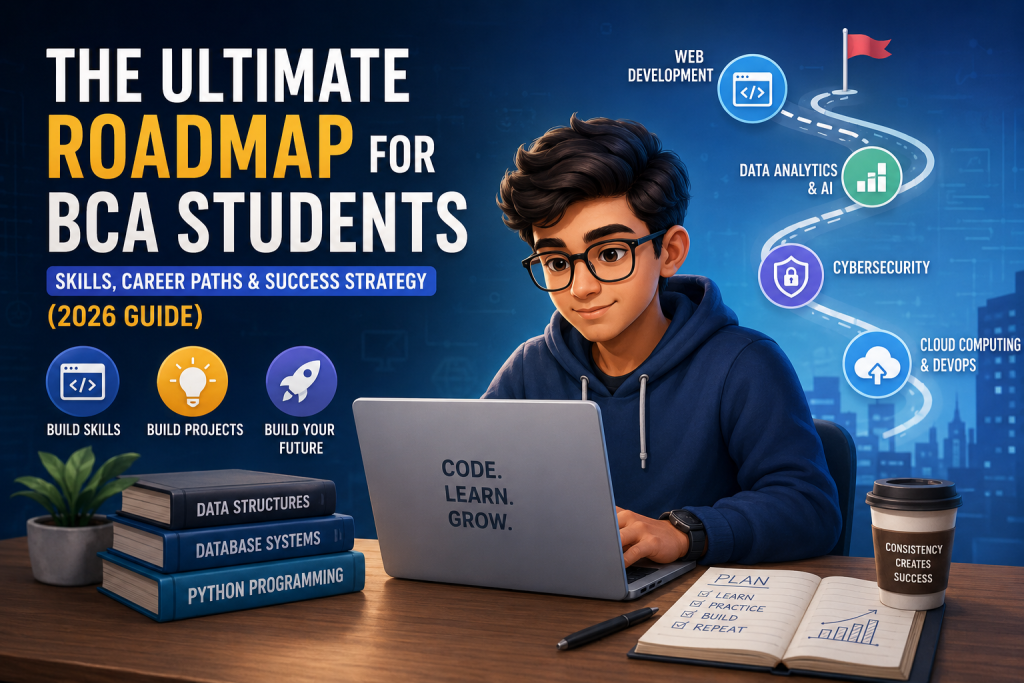
Build Skills. Build Projects. Build Your Future.
Technology is changing faster than ever, and students pursuing a Bachelor of Computer Applications (BCA) are entering one of the most opportunity-driven industries in the world. From software development and Artificial Intelligence to Cybersecurity, Cloud Computing, and Data Analytics, the career possibilities after BCA continue to expand every year.
But in today’s competitive environment, a degree alone is no longer enough.
Companies now expect students to bring practical skills, project experience, communication ability, and real-world problem-solving capabilities to the table. Recruiters are increasingly looking beyond marksheets and focusing more on what students can actually build, solve, and contribute.
This is why having a clear roadmap during college becomes extremely important.
A structured learning approach helps students understand what skills to focus on, when to start preparing, and how to gradually become industry-ready before graduation itself.
This guide explores a practical and realistic roadmap for BCA students in 2026 — from building strong foundations in the first year to preparing for placements, internships, and specialized technology careers.
Why BCA Students Need a Clear Roadmap
One common mistake many students make during graduation is focusing only on semester exams. While academics matter, the technology industry moves much faster than traditional classroom learning.
Today, employers prefer candidates who can:
- Build real-world applications
- Solve practical problems
- Work collaboratively
- Adapt to changing technologies
- Communicate effectively
- Learn continuously
A clear roadmap helps students develop direction early in college. It creates a balance between academics, technical skills, projects, internships, and career preparation.
Students who begin practical learning early often gain a significant advantage during placements and interviews.
First Year of BCA: Focus on Building Strong Foundations
The first year is the ideal time to strengthen programming logic and understand core computer science concepts. Instead of trying to learn everything at once, students should focus on consistency and fundamentals.
Start with Programming Basics
A good starting point is learning:
- C Programming
- Python Programming
C helps in understanding logic building and core programming concepts, while Python introduces students to modern fields such as AI, automation, Data Science, and web development.
At this stage, it’s important to become comfortable with concepts like:
- Variables
- Loops
- Functions
- Arrays
- Conditions
- Basic Algorithms
Even daily coding practice of one hour can create a strong technical foundation over time.
Build Understanding of Core Subjects
Alongside programming, students should gradually strengthen their understanding of subjects such as:
- Operating Systems
- Database Management Systems (DBMS)
- Computer Networks
- Internet Technologies
- Basic Data Structures
These subjects are not only important for university exams but also play a major role during technical interviews and placement preparation.
Learn Essential Development Tools Early
Modern software development relies heavily on tools and collaborative workflows.
This is also the right time to become familiar with:
- Git & GitHub
- VS Code
- Linux Basics
GitHub, in particular, acts as a professional portfolio where students can showcase coding projects and practical work publicly.
Begin Working on Small Projects
Many successful developers start with simple projects during their first year itself.
Mini projects help students apply theoretical concepts practically while improving confidence and creativity.
Some beginner-friendly ideas include:
- Calculator Application
- To-Do List App
- Student Management System
- Weather Application
- Portfolio Website
The goal is not perfection — the goal is learning by building.
Second Year of BCA: Explore Specializations & Build Advanced Skills
The second year is often the turning point in a BCA student’s journey. After building programming fundamentals in the first year, students should begin exploring specialized technology domains based on their interests and career goals.
This is the right time to move beyond theory and start building stronger technical skills, larger projects, and practical expertise in specific areas of technology.
Some students may find interest in web development, while others may explore Artificial Intelligence, Cybersecurity, Cloud Computing, or Data Analytics. The goal during this phase is not to master everything, but to gradually identify a direction and build depth in it.
Web Development: One of the Most In-Demand Career Paths
Web development continues to remain one of the most popular and accessible technology careers for BCA students.
Students interested in this field can begin with:
- HTML
- CSS
- JavaScript
Once the basics become comfortable, modern frameworks like React.js can help students create interactive and responsive user interfaces.
Frontend development focuses on designing user experiences and visually engaging applications.
Project Ideas for Beginners
- Portfolio Websites
- Blogging Platforms
- E-commerce Interfaces
- Responsive Landing Pages
Students who want to move toward Full Stack Development can further explore:
- Node.js
- Express.js
- MongoDB
This combination allows developers to work on both frontend and backend systems.
Full Stack Project Ideas
- Expense Tracker
- Chat Application
- Task Management App
- College ERP System
Full Stack Developers continue to be highly valued across startups, product companies, and IT organizations.
Exploring Data Analytics & Artificial Intelligence
Data is becoming the foundation of modern decision-making, making Data Analytics and Artificial Intelligence among the fastest-growing technology fields globally.
Students interested in this area can start with Python-based analytics tools such as:
- NumPy
- Pandas
- Matplotlib
- SQL
Once comfortable with analytics fundamentals, students can gradually move toward Machine Learning concepts and AI-based projects.
Recommended Project Ideas
- Sales Prediction Systems
- Student Performance Analysis
- Recommendation Systems
- Interactive Data Dashboards
One important thing students should remember is that AI careers require patience and continuous learning. Building a strong foundation matters far more than rushing through advanced topics.
Why Cybersecurity is Growing Rapidly
As businesses and organizations become more digital, the demand for cybersecurity professionals continues to rise.
Students interested in ethical hacking, digital security, and system protection can begin by learning:
- Linux
- Networking Fundamentals
- Web Security Basics
- Ethical Hacking Concepts
Popular tools such as:
- Kali Linux
- Wireshark
can help students understand how cybersecurity professionals monitor and protect systems.
Certifications like CEH (Certified Ethical Hacker) and Security+ can also strengthen career opportunities in this field.
Cloud Computing & DevOps: The Future of Modern IT
Cloud Computing has become an essential part of modern technology infrastructure.
From startups to global enterprises, organizations now rely heavily on cloud platforms and automated deployment systems.
Students can begin exploring:
- AWS Basics
- Docker
- Linux Administration
- CI/CD Pipelines
A beginner-friendly certification like AWS Cloud Practitioner can provide a strong introduction to cloud technologies and industry practices.
Cloud and DevOps professionals are increasingly in demand because companies now prioritize scalable and automated systems.
Third Year of BCA: Becoming Industry Ready
The final year of BCA should focus more aggressively on career preparation, internships, and portfolio building.
This is the phase where students transition from learners to professionals.
Build Resume-Worthy Projects
By the third year, students should aim to build a portfolio that demonstrates practical skills clearly.
A strong student profile usually includes:
- 3–5 major projects
- GitHub portfolio
- LinkedIn profile
- Internship experience
Projects often speak louder than certificates because they showcase practical implementation ability.
Strengthen Data Structures & Algorithms (DSA)
DSA remains one of the most important areas for technical interview preparation.
Students should regularly practice concepts like:
- Arrays
- Linked Lists
- Trees
- Graphs
- Recursion
- Dynamic Programming
Consistency matters more than solving hundreds of problems quickly. Regular practice builds confidence gradually.
Communication Skills Matter More Than Many Students Realize
Technical skills are important, but communication often becomes the deciding factor during interviews and professional growth.
Students who improve:
- Public Speaking
- Group Discussion Skills
- Presentation Ability
- Interview Communication
usually perform better during placements and workplace interactions.
Strong communication skills also create leadership opportunities later in professional careers.
Certifications That Add Value for BCA Students
Certifications become much more effective when combined with projects and practical implementation.
Some widely recognized certifications include:
- AWS Cloud Practitioner
- Google Data Analytics
- Meta Frontend Developer
- Microsoft Azure Fundamentals
- IBM Data Science
- Machine Learning by Andrew Ng
Students do not need to complete every certification available online. Choosing one specialization and building depth is usually more beneficial.
Career Opportunities After BCA
A BCA degree can lead to several exciting career opportunities in the technology sector.
Some popular roles include:
| Career Role | Recommended Skills |
| Software Developer | DSA + Full Stack Development |
| AI Engineer | Python + Machine Learning + SQL |
| Data Analyst | Excel + SQL + Power BI |
| Cloud Engineer | AWS + Linux + DevOps |
| Cybersecurity Analyst | Networking + Linux + Security |
With continuous learning and industry experience, these careers can offer strong long-term growth opportunities.
A Practical Weekly Routine for BCA Students
Many students assume success requires studying for 10–12 hours daily. In reality, consistency creates better long-term results than intensity.
A balanced weekly routine may include:
- Daily coding practice
- Skill learning sessions
- Weekend project building
- Weekly GitHub updates
- Monthly mock interviews
Small improvements made consistently over time often create significant career advantages.
What Companies Actually Look For During Hiring
Most companies evaluate students based on a combination of technical and professional skills.
Recruiters generally look for:
- Problem-solving ability
- Real-world projects
- Internship experience
- Communication skills
- GitHub portfolio
- Learning attitude and consistency
CGPA still matters in some organizations, but practical skills and project exposure often play a bigger role during technical hiring.
A Final-Year Checklist Before Graduation
Before completing BCA, students should ideally have:
- A professional resume
- Optimized LinkedIn profile
- GitHub portfolio
- Internship experience
- Multiple strong projects
- Basic interview preparation
- At least one specialization area
This preparation significantly improves placement readiness and career opportunities.
Learning the Right Skills with Industry-Oriented Guidance
Building a successful technology career becomes easier when students receive the right mentorship, practical exposure, and learning environment during college.
Institutions like CIMAGE Group of Institutions focus on combining academics with practical skill development, project-based learning, communication training, internships, and placement preparation.
Students today benefit most from environments where they are encouraged to build projects, participate in workshops, improve technical skills, and gain exposure to emerging technologies like AI, Cloud Computing, Cybersecurity, and Data Analytics.
Practical exposure, mentorship, and consistency often make a major difference in shaping long-term career outcomes.
Conclusion
Success in BCA is not about learning every technology at once. It is about building strong fundamentals, learning consistently, and applying knowledge through projects and practical experience.
Students who focus on:
- Coding practice
- Real-world projects
- Communication skills
- Internships
- Continuous improvement
usually gain a strong advantage during placements and career growth.
Technology rewards learners who stay curious, adaptable, and willing to improve continuously.
The best time to start building a strong future in technology is during college itself.
Frequently Asked Questions (FAQs)
- Is BCA a good career option in 2026?
Yes, BCA remains one of the most promising career-oriented courses for students interested in software development, Artificial Intelligence, Data Analytics, Cybersecurity, and Cloud Computing.
2. Which skills are most important for BCA students?
Programming, problem-solving, communication skills, project building, web development, database management, and GitHub usage are among the most valuable skills for BCA students.
3. Can BCA students get high-paying jobs?
Yes. Students who focus on practical learning, internships, specialization, and projects can build strong careers in the technology industry with excellent long-term growth opportunities.
4. Is coding necessary for BCA students?
Coding forms the foundation of most technology careers. Regular coding practice helps students improve logical thinking, problem-solving ability, and technical confidence.
5. Which specialization is best after BCA?
Popular specialization options include:
- Full Stack Development
- Artificial Intelligence
- Data Analytics
- Cybersecurity
- Cloud Computing
- DevOps
The best choice depends on individual interest and career goals.
6. How can BCA students prepare for placements?
Students should focus on coding practice, DSA preparation, communication skills, internships, project building, resume preparation, and mock interviews.
7. Do practical skills matter more than marks?
Both academics and practical skills are important, but companies increasingly prefer candidates who can demonstrate real-world problem-solving and project experience.
About the Author